Sunlight begins its quiet comeback across Canada sooner than you'd think

We still have plenty of long, dark days ahead of us, but there’s a bright spot amid a sea of early sunsets
We’re quickly approaching the shortest days of the year across Canada as the winter solstice draws near.
But did you know that the earliest sunsets of the year are much closer than they seem?
DON'T MISS: Welcome to meteorological winter!
Solar time doesn’t follow our clocks
This year’s winter solstice occurs on Dec. 21, when the Sun’s direct rays reach their southernmost extent and folks in the northern hemisphere experience the shortest day of the year.
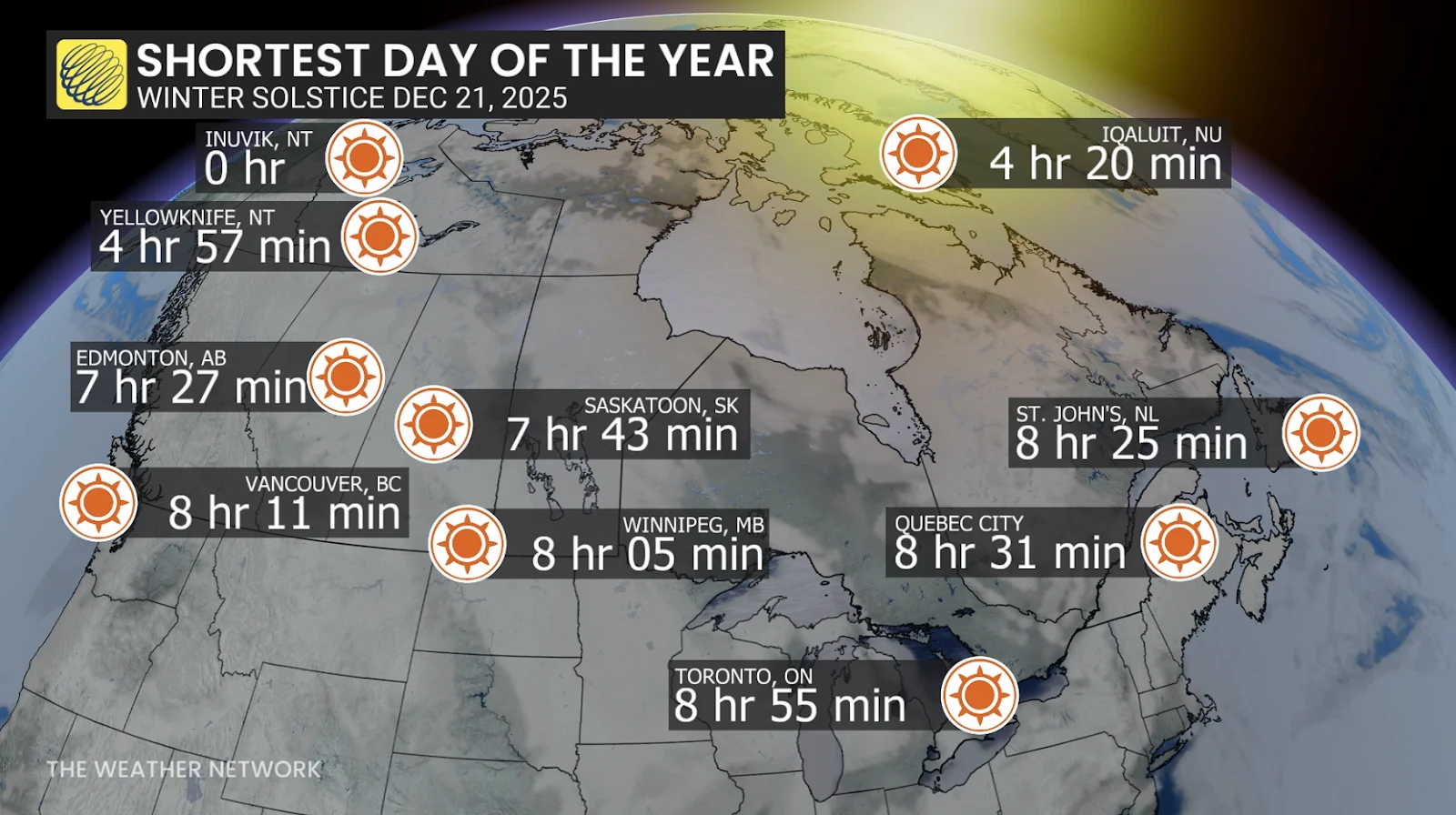
While the solstice comes in with the fewest hours of daylight, the year’s earliest sunsets can actually occur up to two-and-a-half weeks in advance of that momentous occasion.
For example, let’s head over to St. John’s, where the sunset will occur around 4:12 p.m. local time on the winter solstice. Even though that’s the shortest day of the year with about 8 hours and 58 minutes of daylight, the year’s earliest sunset actually occurs on Dec. 11, when the sun will dip below the horizon at 4:09 p.m.

If that’s the case, then why is the solstice the shortest day of the year? The sunrise gets later faster than the sunrise grows earlier, accounting for the shortened length of daylight.
We experience this phenomenon because Earth doesn’t orbit the Sun in a perfect circle. Our planet’s elliptical orbit changes how solar time lines up with our calendar. This is also why the Sun appears to trace a figure-eight in our sky throughout the year.
We’ve lost lots of daylight since the start of summer
Folks with seasonal affective disorder don’t need a reminder that our days are shorter. But how much shorter have they gotten since the longest day of the year?

Yellowknife loses about 15 hours of daylight between the summer and winter solstices.
St. John’s sheds about 7.5 hours of daylight between those two dates, and Toronto ‘only’ loses about 6.5 hours of daylight throughout the latter half of the year.
Header image courtesy of Unsplash.