
Scientists find unusual structure under Bermuda that causes it to ‘float’

As far as we know, there are no other structures like this in the world,
Popular culture may frame Bermuda as a place where ships and planes go missing, but there’s another puzzling aspect of this area that scientists have been studying for decades.
The island appears to “float” above the surrounding ocean, and a pair of researchers think they may have discovered why.
In a new study appearing in the journal Geophysical Research Letters, William D. Frazer of Carnegie Science and Jeffrey Park of Yale University’s Department of Earth and Planetary Sciences say they’ve discovered a 20-kilometre thick layer of rock beneath Bermuda between Earth’s crust and mantle.
Bermuda is a volcanic island, but Frazer and Park say it’s “fundamentally different” from other volcanic islands. Bermuda sits on an elevated region of sea floor called a bathymetric swell, like its counterparts, but that’s where things diverge.
“Bermuda is an intraplate ocean swell that does not conform to traditional mantle plume theory,” the authors write in the study.
“Unlike other prominent bathymetric swells, such as Hawaii, it lacks age-progressive volcanism, a deeply rooted mantle plume, and modern volcanism.
In other words: In some conditions, swells form, in part, due to heat from a rising column of hot rock, or a plume. But there is no scientific evidence to date of a hot mantle plume beneath Bermuda.
Speaking with Live Science Frazer says Bermuda's swell hasn't dissipated, an anomaly given there is no recorded evidence of a volcanic eruption in the area for more than 30 million years.
While there is debate about what activity may be occurring in the mantle underneath Bermuda, no eruptions have been observed at the surface, he told the publication.
For their paper, Frazer and Park analyzed data from a seismic station on the island. When sound waves from distant earthquakes hit layers of Bermuda’s rock, they were able to map the island’s makeup.
In doing so, they identified its base, crust, and mantle, as expected. But they also discovered a “secret” layer that’s two to three times thicker than what has been documented at other typical ocean islands, and this could explain why Bermuda didn’t sink after its volcanoes stopped erupting more than 30 million years ago.
Frazer and Park suggest this newfound layer was made during an eruption long ago and composed of magma that cooled into a rock-type substance slightly cooler than the mantle around it, creating a buoyancy that holds up the swell instead of heat, as is the case with other, somewhat similar islands.
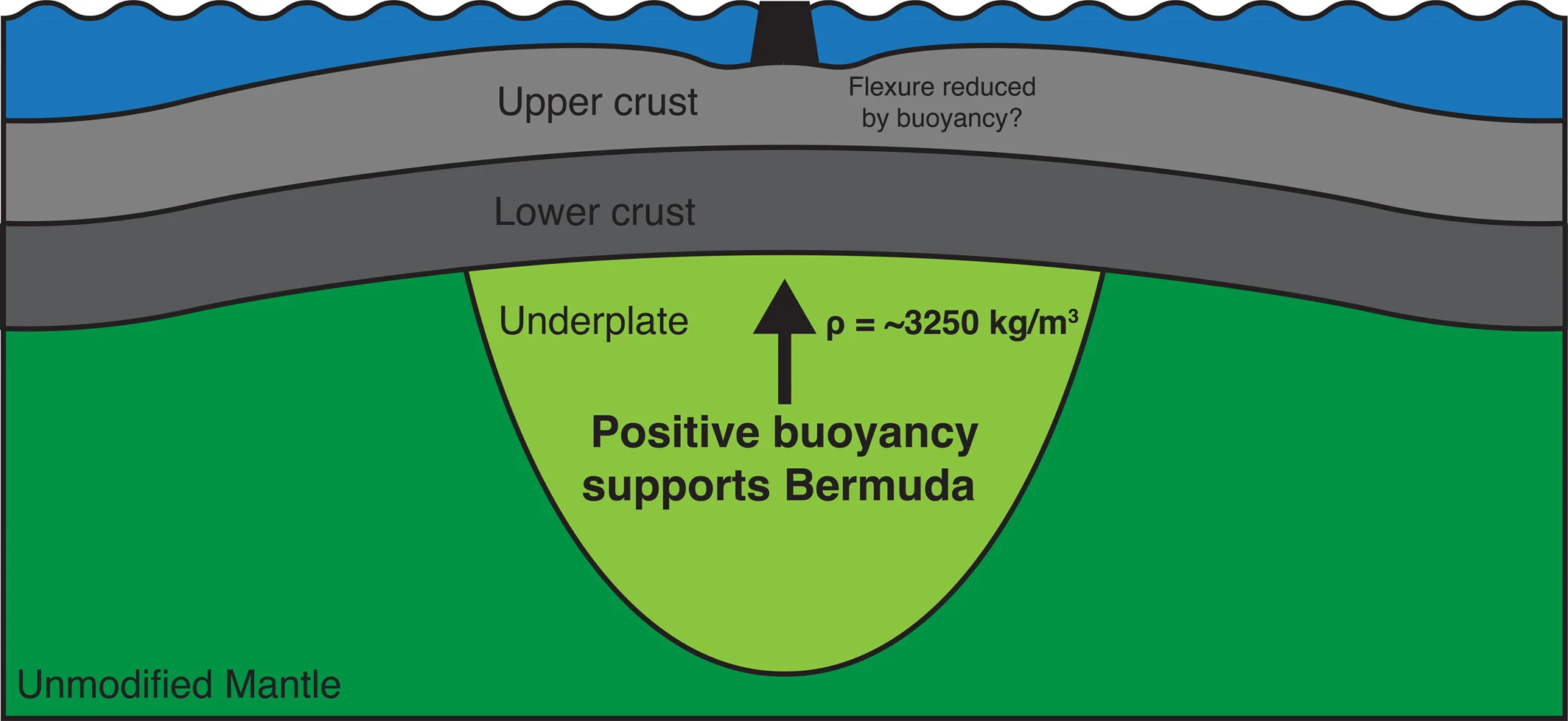
An illustration of Bermuda's intrepreted features. (Frazer and Park, Geophysical Letters)
“This thick layer beneath the crust likely was emplaced when Bermuda was volcanically active 30–35 million years ago and could support the bathymetric swell,” the authors say in their study.
As far as we know, there are no other structures like this in the world, making Bermuda distinctly unique.
Ancient volcanic eruptions, and their impacts, have been in the news a lot lately. Earlier this month, a paper was published detailing a tropic eruption that occurred around 1345 AD that caused prolonged cold and wet weather in parts of Europe.
This damaged crops and led to famine, kickstarting a chain of events the led to the spread of the Black Death pandemic.
Header photo: File photo of Bermuda from Canva Pro.