A titanic ‘tug-of-war’ inside Earth is changing the length of our days

Two Canadian researchers may have discovered the source of the multi-decades-long changes in Earth's length of day.
It may sound like something out of ancient mythology, but titanic forces deep inside the Earth are locked in an eternal tug-of-war, and this struggle appears to be the cause of our days getting longer and shorter over time.
Even though our clocks track exactly 24 hours, each and every day, the length of our day is almost constantly changing. This isn't the seasonal change, where the amount of daylight varies as we progress through a year. This is actually the length of time it takes our planet to rotate on its axis.
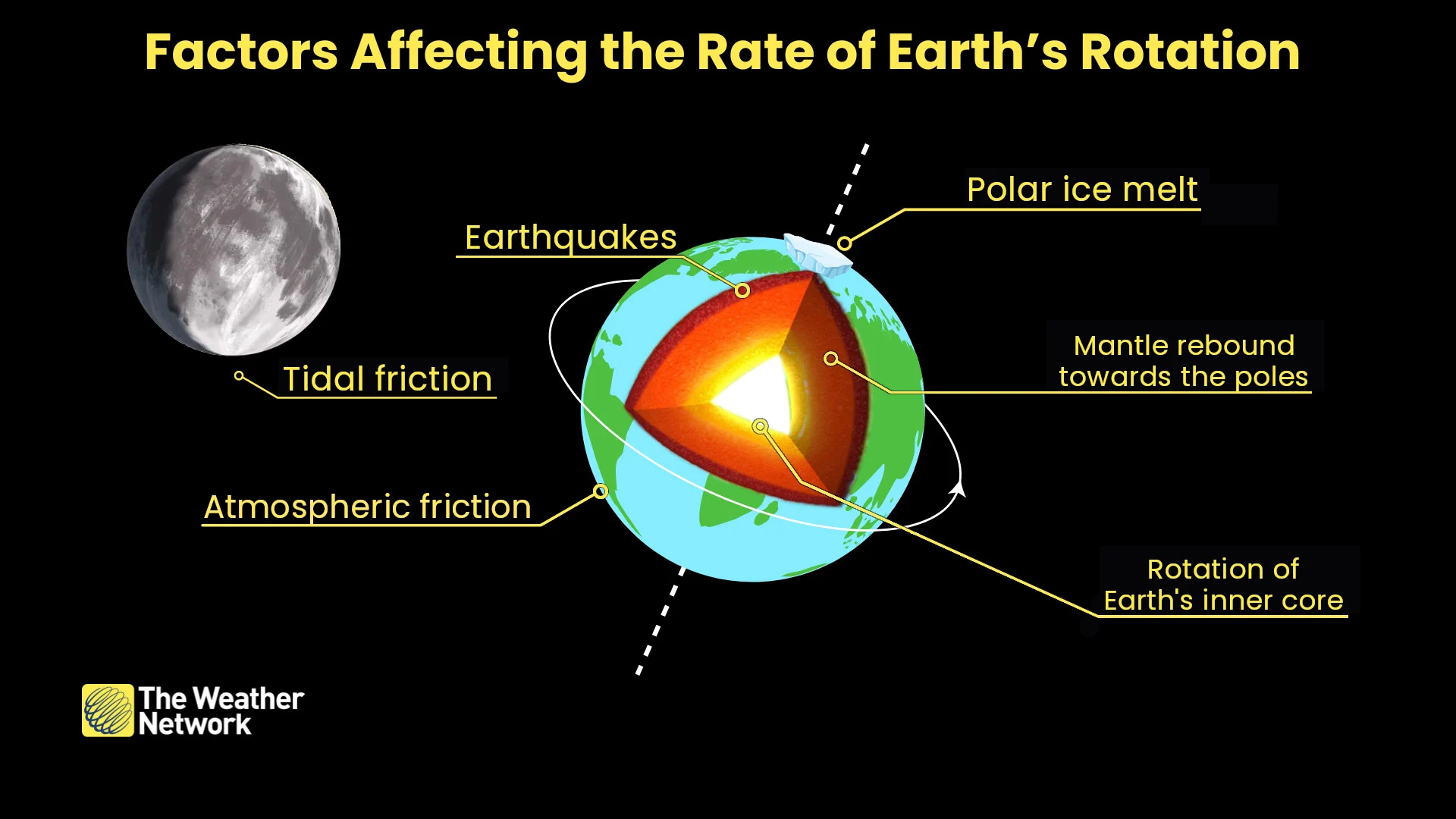
Tidal friction from the Moon, earthquakes, atmospheric friction, and shifts in the planet's mass balance due to ice growing and shrinking at the surface — all of these things can impact the exact length of our day.
READ MORE: Earth just had one of its shortest days in over 50 years
As a result of these changes, we've seen headlines like "Earth just had one of its shortest days in over 50 years" in recent years. The differences were hardly noticeable without the most precise time-keeping instruments humans have ever built. However, they existed, nonetheless.
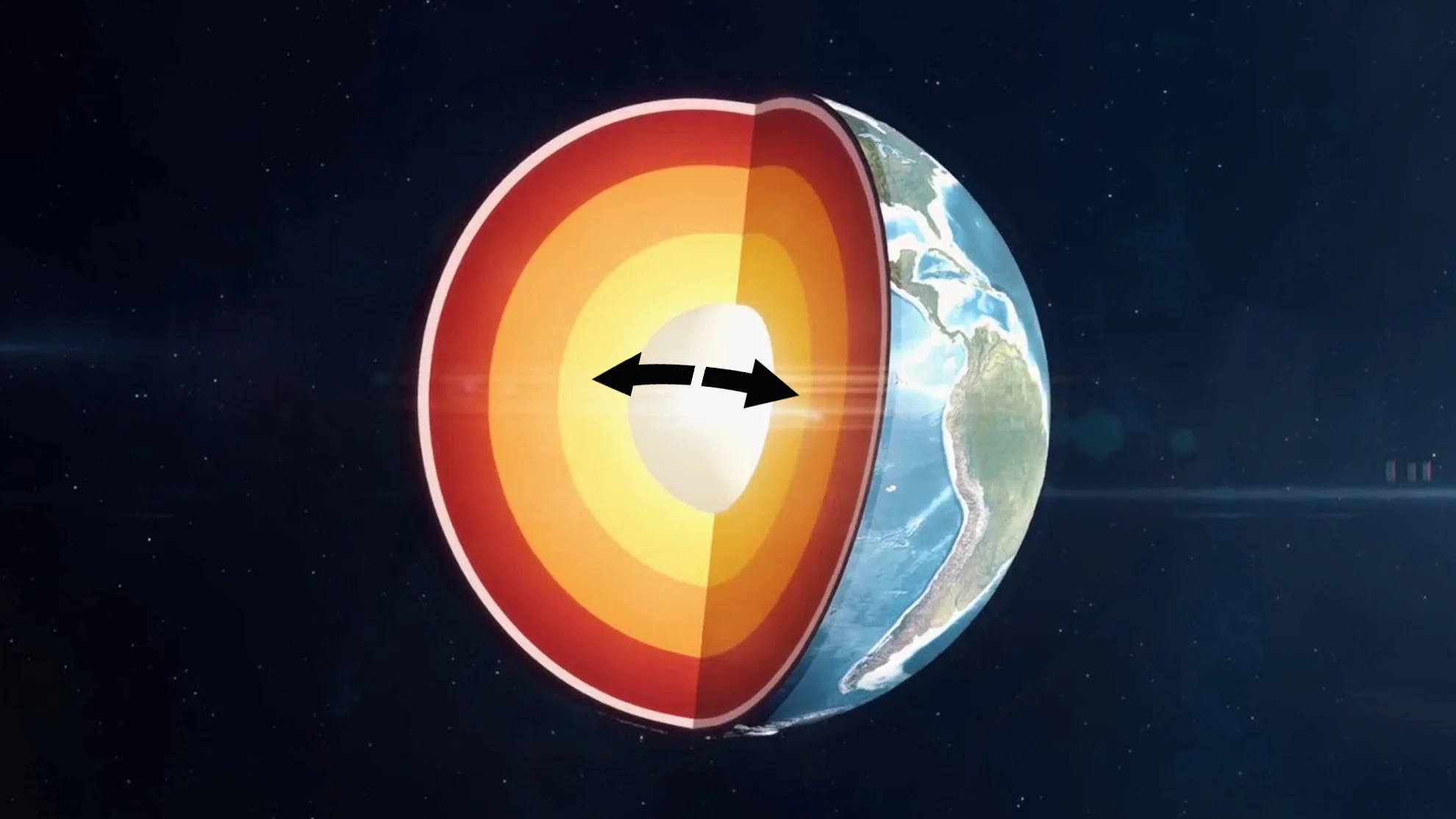
Another factor that influences the planet's spin is the interaction between the innermost layers of Earth's interior — the solid inner core, the liquid outer core, and the solid mantle that surrounds them.
Basically, Earth's solid inner core rotates along with the planet. However, because it is embedded within the liquid outer core, it doesn't necessarily spin at exactly the same speed as everything else. Sometimes, it spins faster or slower.
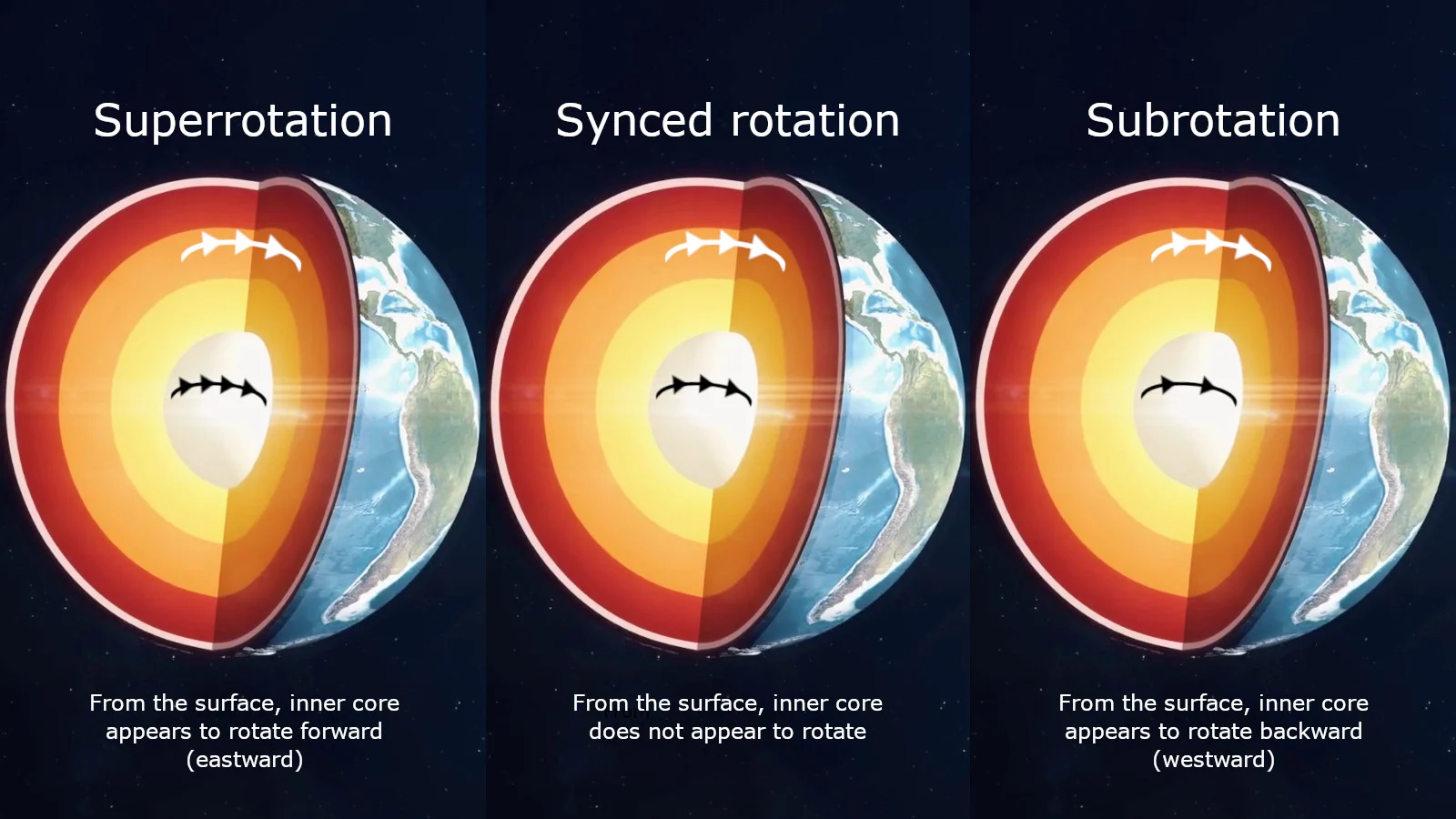
This cut-away diagram of Earth's interior demonstrates the different rates of rotation of the inner core relative to the mantle and crust. (Storyblocks/SpaceStockFootage/Scott Sutherland)
Due to everything within the planet being in physical contact with everything else, Earth acts as a closed system. As a result, the way that it spins is governed by the law of conservation of angular momentum. Essentially, this means that if there are no external forces acting on it to change the way that it spins, the planet's total rate of spin cannot change.
For example, the Moon exerts an external force on Earth. This results in the tides, which slow the planet's rotation by around 1-2 milliseconds per century. The added tidal friction from the Sun tacks on another half a millisecond to that rate.
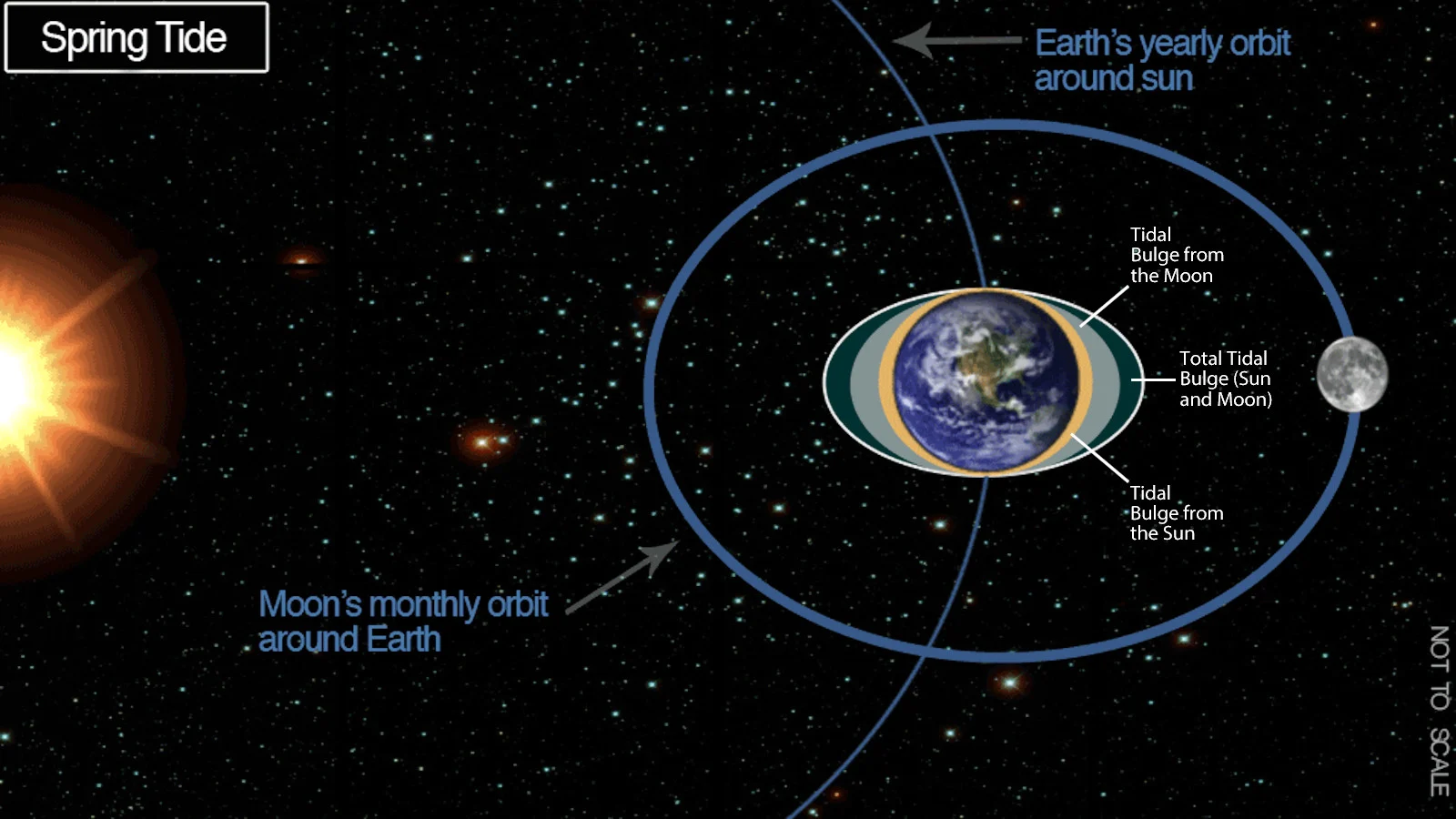
(NOAA)
RELATED: Earth's core confirmed to have 'reversed' its spin. So what does this mean?
Just taking the forces within the planet, though, any changes in rotational speed by one part must be balanced by some other part, so that the change to Earth's total angular momentum is zero.
So, if the spin of the solid core speeds up, its angular momentum increases, but it needs to get that added momentum from somewhere. It effectively 'steals' it from the rest of the planet. As a result, the angular momentum of the mantle and crust decreases, which means that they spin slower, and the length of our day increases.
Conversely, if the core slows down, the angular momentum it loses in the process is transferred to the rest of the planet. That causes the mantle and crust to speed up, which shortens the length of our day.
Up until now, we've seen the changes in our length of day, both in the short term (daily) and the long term (over decades). What we've learned about the interior of the planet gives us good explanations for why we see the short-term changes, and has shown that the long-term changes have something to do with interactions between the core and the mantle.
However, exactly what core-mantle interaction is responsible for the long-term, multidecadal changes has remained a mystery.
What's new, now?
A new paper published in the journal Nature, by PhD student Huifeng Zhang and professor Mathieu Dumberry, both at the University of Alberta's physics department, may have solved that mystery.
Their research shows that a tug-of-war between different twisting forces is behind the multi-decades-long back and forth that has occurred in our length of day.
On one side are two torques exerted by the outer core onto the mantle, and on the other is a torque exerted by the inner core onto the mantle.
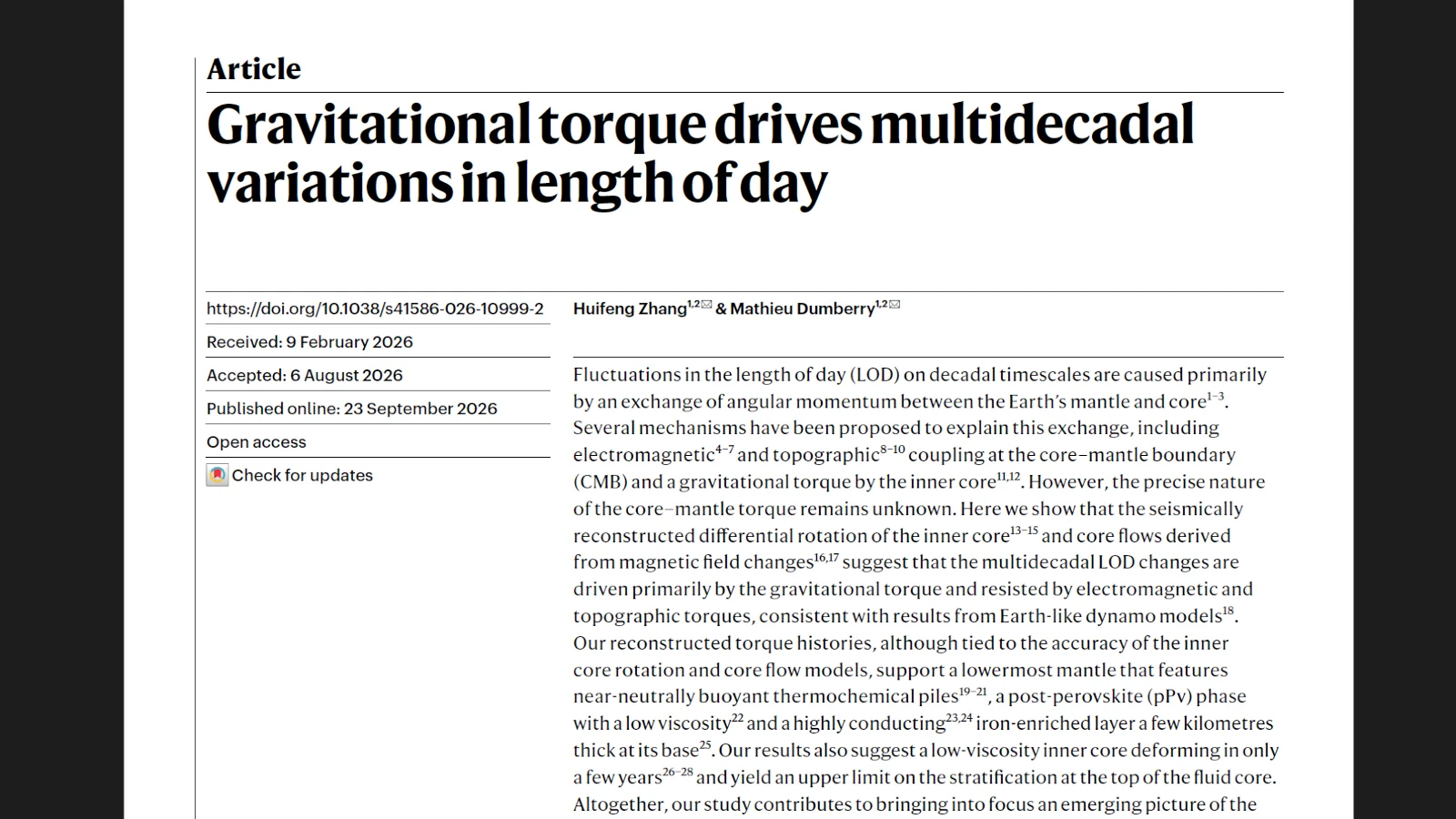
(Zhang & Dumberry/Nature)
Just for simplicity, diagrams of Earth's interior (such as those shown above) often depict the different layers as perfect concentric solid spheres. However, the reality is more complex.
The mantle is, indeed, solid, but its inner boundary is jagged and rough. This rough surface gives the liquid metal circulating around in the outer core something to exert pressure and friction on. Also, two immense regions of the mantle, one under Africa and the other under the Pacific Ocean, have slightly higher density than the rest. Thus, these 'large low-velocity provinces' (LLVPs) exert a stronger gravitational pull on the core.
This wouldn't matter if the inner core was a completely smooth solid metal ball. However, the outer layer of the solid core is viscous enough that it can deform under pressure from the outer core, and from the gravitational pull of the mantle. The result is a core that is stretched into a slight oval shape by the stronger gravity of the LLVPs, with the equilibrium position of the axis of that oval aligned between them.
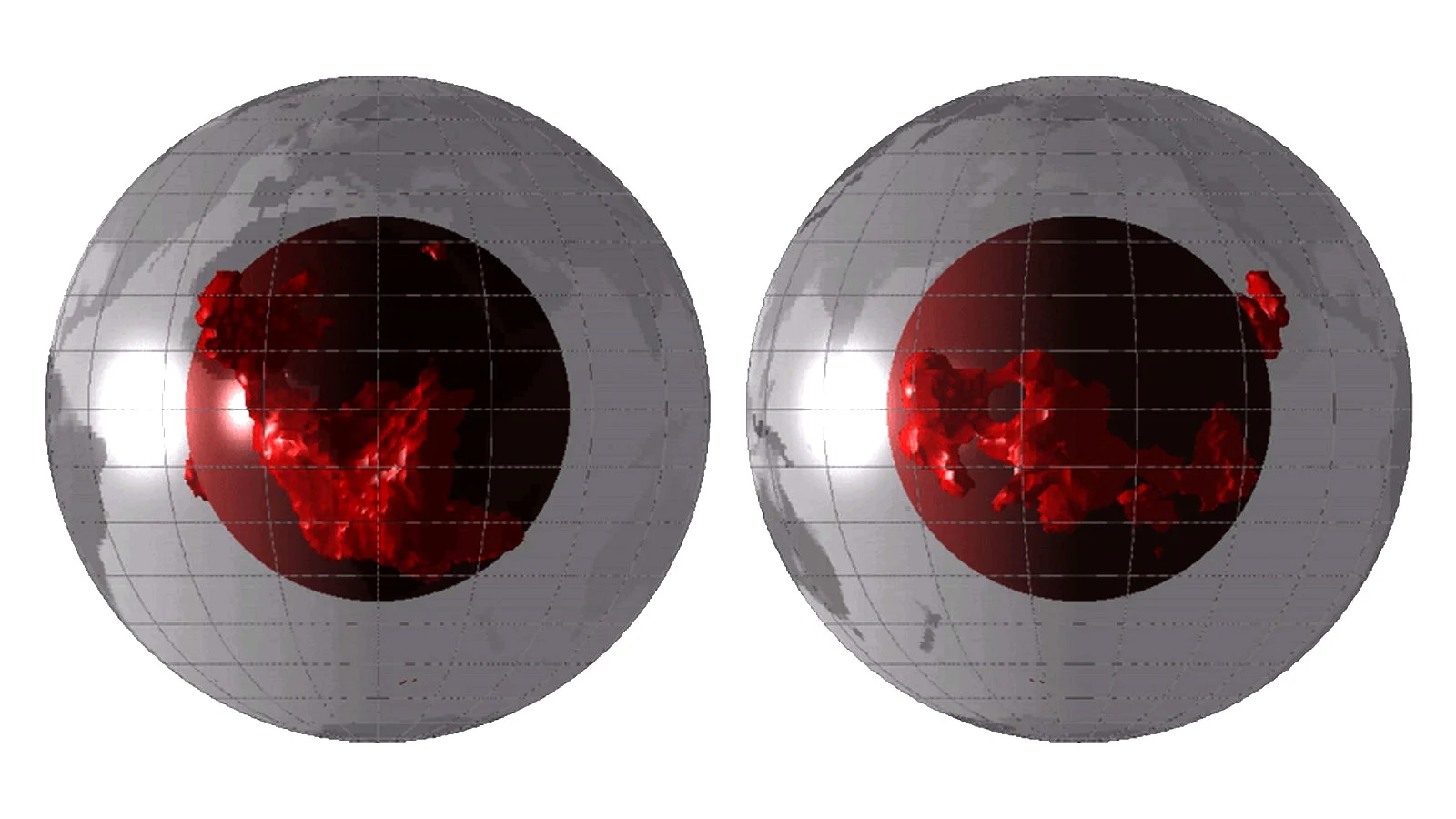
Two views of Earth are shown here, depicting the locations of the two large low-velocity provinces (LLVPs) at the base of Earth's mantle. (Sanne Cottaar (CC BY-SA 4.0))
DON'T MISS: Blobs of an alien world may lurk deep inside the Earth
As Zhang and Dumberry explained in their paper, the inner core experiences differential rotation due to this oval shape. That is, the material of the core spins faster the farther it is from the exact centre. And, as that differential rotation occurs, along with the viscous deformation of the outer layer, it results in the axis of the core slipping out of its equilibrium position.
This causes gravitational torque, as the pull of gravity between the inner core and the LLVPs attempts to sync up their rotation and put the core back into equilibrium.
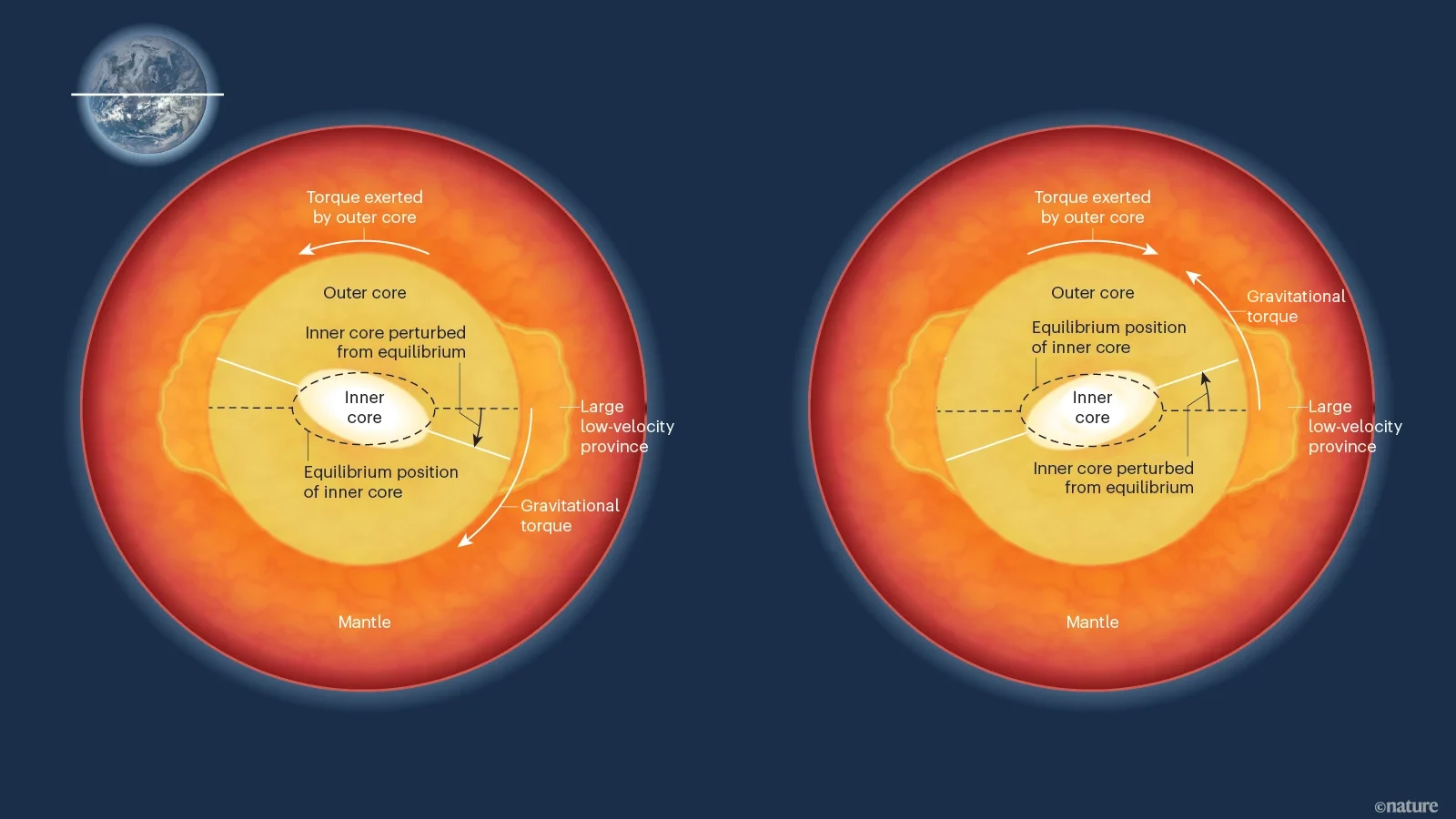
These cross-sections of Earth are cut across the equator, with the planet rotating counter-clockwise. In both, the solid inner core (with exaggerated oval shape) is shown displaced from its normal position lined up with the two LLVPs (dashed oval), clockwise on the left and counterclockwise on the right. The different torques this produces are shown, as the induced gravitational torque is resisted by the torques from the outer core. (Adapted from Nature, Zhang & Dumberry)
When that gravitational torque is applied, though, two other forces step in to resist it. The first is the frictional torque exerted on the inner rough boundary of the mantle by the outer core. The second is an electromagnetic torque produced by the electrical currents and magnetic fields generated by the molten iron circulating in the outer core.
The gravitational torque is stronger, and thus gradually wins out in this tug-of-war, but the resisting torques keep its progress slow. Thus, the changes in the planet's rate of rotation from this happen across long spans of time, on the order of around 60-70 years.
In addition to solving this mystery, Zhang and Dumberry point out in their paper that this research also provides new insights into the structure of our planet's core.
"Altogether, our study contributes to bringing into focus an emerging picture of the deepest regions of our planet," they wrote.
(Thumbnail image courtesy Storyblocks)