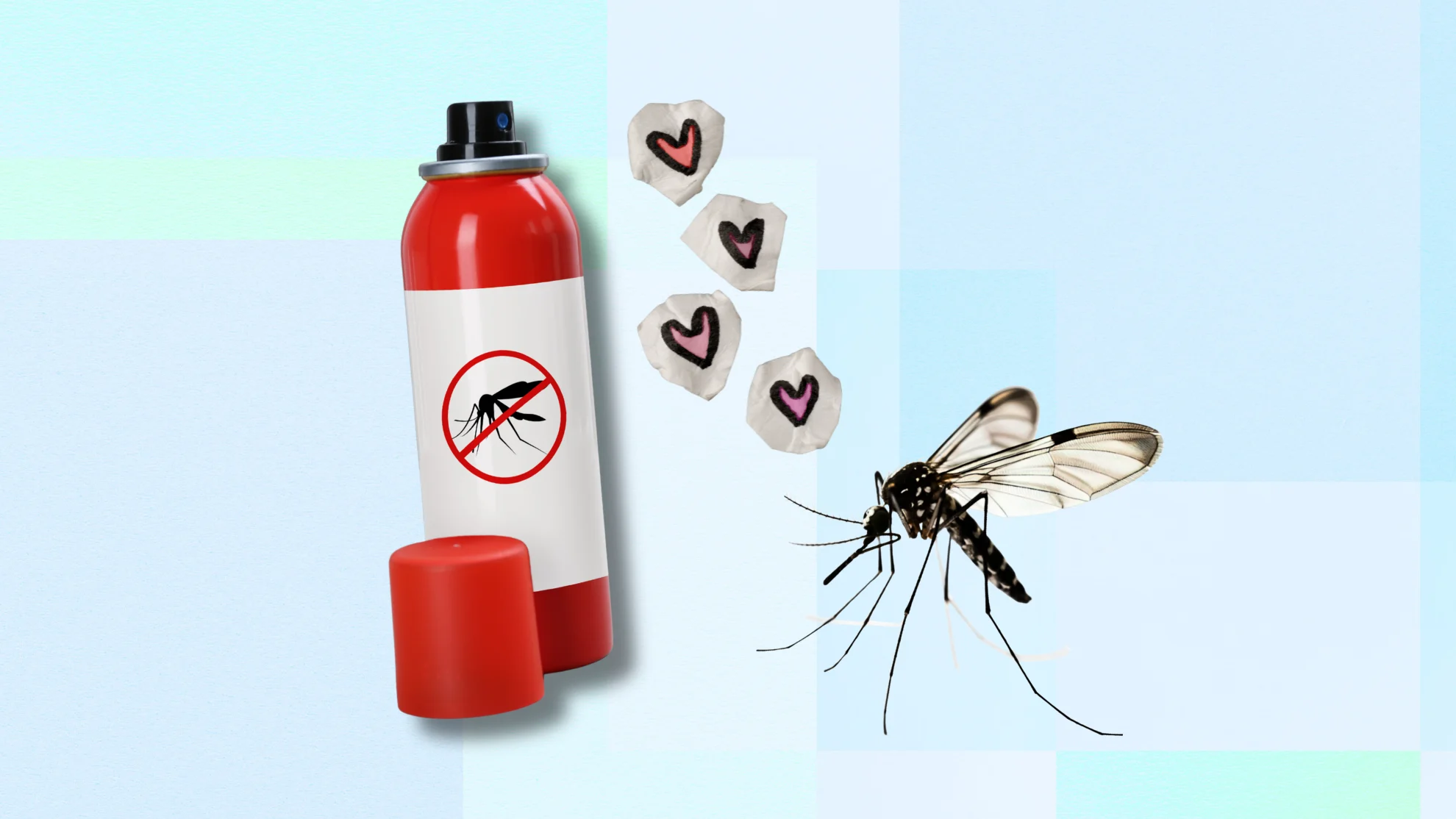
Mosquitoes may be learning to associate DEET with food

While the findings suggest some mosquitoes are adapting, the study's authors stress that DEET remains an effective insect repellent.
Some mosquitoes are learning to associate the smell of DEET with food, according to a new study from researchers at Virginia Tech and the University of Tours in France.
DEET is still considered one of the most effective insect repellents, but the study suggests that the yellow fever mosquito, or Aedes aegypti, may be learning to live with DEET and could even become attracted to it.
DON'T MISS: Visit our complete guide to Summer 2026 for an in-depth look at the Summer Forecast, tips to plan for it and much more!
"If someone applies DEET and the concentration fades over time, but a mosquito still manages to feed, the insect may begin associating that smell with a reward," Clément Vinauger, associate professor at Virginia Tech, says in a statement.
"That's a possibility we should take seriously when we think about how repellents are used in the real world."
The yellow fever mosquito can spread several diseases, including dengue fever, Zika, yellow fever, and chikungunya.
It primarily lives in tropical and subtropical regions. It is not present in Canada, as it cannot survive our harsh winters.
Mosquitoes can learn?
For their experiment, researchers presented mosquitoes with warm blood in a bag. When they started feeding, theyintroduced the scent of DEET.
They repeated the experiment four times. By the fourth attempt, 60 per cent of the mosquitoes tried to feed when presented with only DEET.
In the next experiment, mosquitoes were given a choice of two human hands — one untreated and another treated with DEET.
They found that untrained mosquitoes avoided the DEET-coated hand. Meanwhile, the mosquitoes trained in the previous experiment appeared drawn to the hand containing DEET.
More than chemistry
“The common assumption has always been that repellents work because of their chemistry — that DEET simply smells bad to mosquitoes and they flee or that its chemistry prevents mosquitoes from smelling us,” Vinauger says.
RELATED: Where are Canada's mosquito hotspots?
“But what we are showing is that the mosquito’s brain can rewrite that response based on experience. What the insect has learned matters just as much as what the chemical does. That, I think, is a paradigm shift.”
DEET still the best defense
Vinauger says people should not stop using DEET as it’s still one of the most effective repellents.
"If you're in tropical regions where disease risk is real, you should use it," he says.
"Instead of applying a lot at once, you may want to reapply regularly so it's always active and providing continuous protection.”
Spraying your clothing with DEET may not be as effective, as concentrations in fabric weaken throughout the day.
“We need to understand how mosquitoes keep outsmarting our control strategies,” Vinauger says.
“And that takes understanding how they work — at the molecular level, the neural level, the behavioural level."
Making mosquitoes feel unwelcome
In addition to DEET, you can limit your exposure to mosquitoes on your property by:
Reducing standing water, which is a common breeding ground for mosquitoes.
Cleaning your eavestrough.
Replacing the water in bird baths and pet water dishes at least two times a week.
If you plan on spending time outdoors:
Use insect repellent on your exposed skin. Look for ingredients recommended by health officials.
Wear long sleeves, pants, and socks.
Limit outdoor activities between dusk and dawn when mosquitoes are most active.
Header image: Created by Cheryl Santa Maria for The Weather Network using elements from Canva Pro.