Major sewage spill near Washington approaches largest in U.S. history

The spill has dumped nearly 1 billion litres of wastewater into the Potomac River since the middle of January
A large sewer line collapse near Washington, D.C., has dumped more than 900 million litres (243 million gallons) of wastewater into the Potomac River basin over the past several weeks.
This is one of the largest wastewater spills in American history.
RELATED: More than half of the world's rivers impacted by human activity
Major wastewater spill near Washington, D.C.
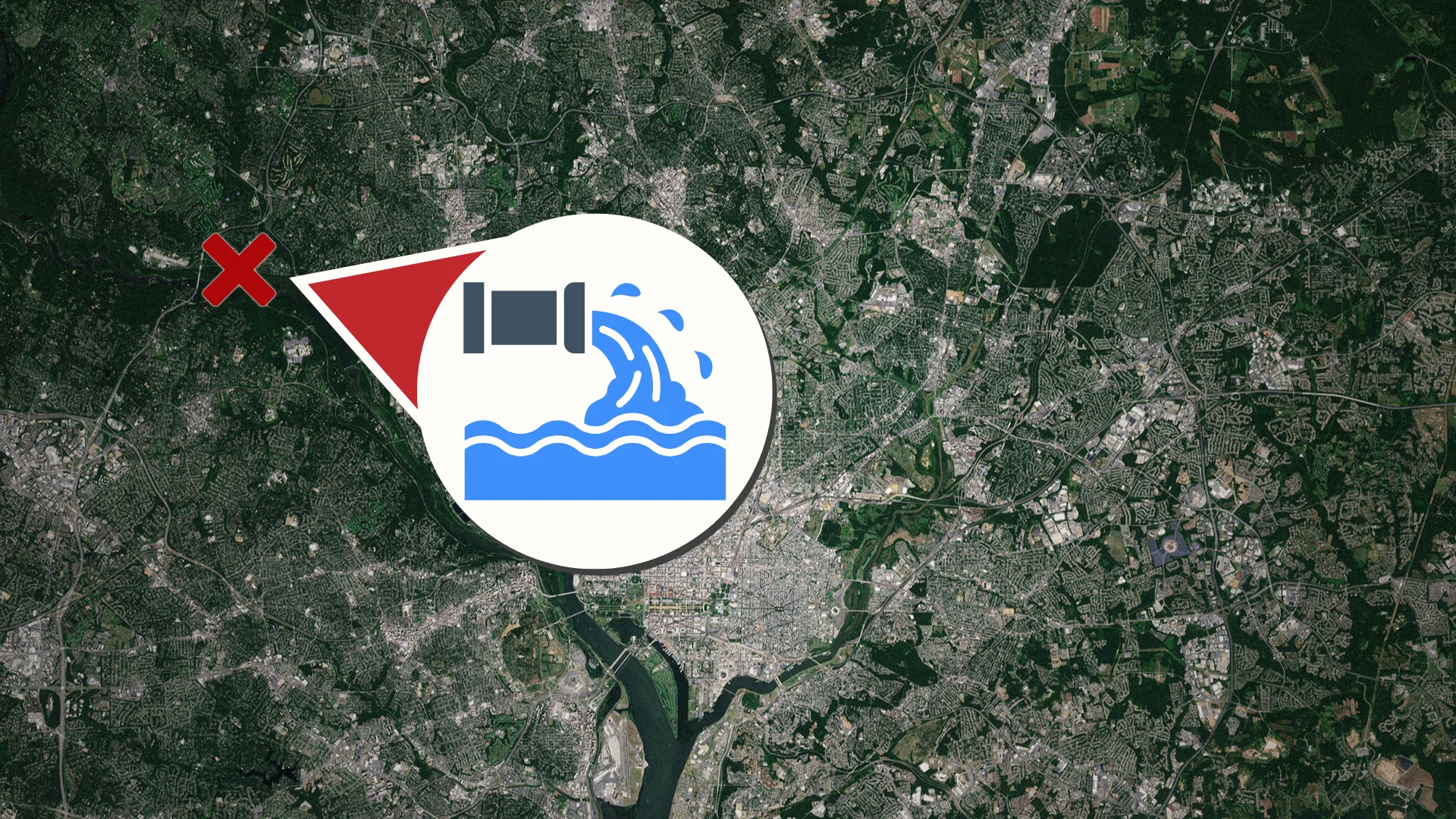
The incident began on Jan. 19 when a large sewer line known as the Potomac Interceptor (PI) broke beneath a roadway along the Potomac River about 14 km upstream from the heart of Washington, D.C. The break released a steady stream of untreated wastewater into the local environment.
DC Water said in a release on its website that “the PI carries about 60 million gallons [227 million litres] of wastewater daily” from as far away as Washington-Dulles Airport.

SEE ALSO: The world is officially in its water bankruptcy era
Wastewater continued flowing from the broken pipe for five days until crews were able to implement a bypass system.
Officials estimate that more than 900 million litres (240 million gallons) of wastewater have spilled into the environment, including the river itself, since the initial break.
This is one of the largest wastewater spills in U.S. history, far exceeding a 2017 spill that released more than 500 million litres (143 million gallons) of untreated water into the Tijuana River in southern California.
Widespread contamination around the spill site
Significant contamination occurred around the site of the break. Water samples on Feb. 10 showed E. coli measurements of 600,000 MPN/100 mL near the collapse, which is about 1,463 times higher than the recommended upper limit for swimming safely in a body of water.
Dangerously high levels of E. coli were measured in the Potomac River as far downstream as Georgetown, a neighbourhood in Washington, into the beginning of February before the levels receded.
Researchers from the University of Maryland also found elevated levels of staph in the water, as well as an antibiotic-resistent strain known as MRSA.
Header image created using graphics and imagery from Canva and ESA.