
This destructive plant starts sprouting in Canada in March. Removal takes years

Eradication can take several years. Experts say catching it early is best.
Parts of the UK are on high alert for signs of Japanese knotweed, a highly invasive, fast-growing, and hardy plant that can cause all kinds of problems for property owners.
It creates strong and far-reaching rhizomes, or stems, that can damage a home’s foundation and crack pipes.
Removal can take years and cost thousands of dollars, and that's on top of the cost to repair any associated structural damage. In some parts of Canada, like B.C., homeowners are legally obligated to remove Japanese knotweed if it is discovered on their property.
Mild weather and lots of rain in the UK this time of year have caused the plant to start sprouting, and in the right conditions, it can grow up to 10 centimetres per day.
This is a big problem: When selling a home in the UK, the owner must declare if Japanese knotweed is present on the land. If it is, it can devalue the property by as much as 15 per cent.

A flowering Japanese knotweed. (W. Carter/Wikipedia) CC0.
Not so fast, Canada
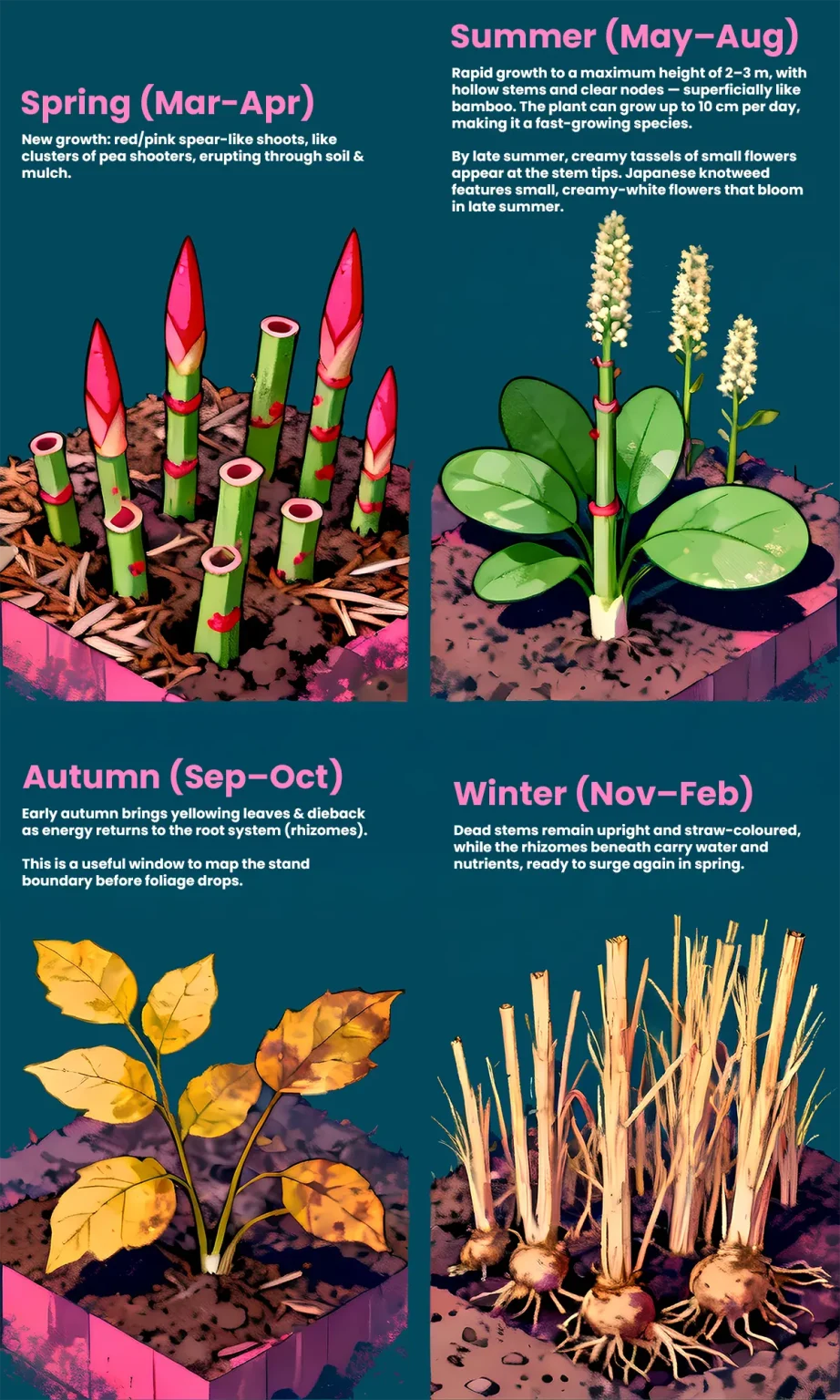
Unfortunately, Canada isn’t in the clear: Our Japanese knotweed usually starts growing in late March or April, fueled by mild weather and heavy spring rainfall.
“Japanese knotweed’s story follows an innocent plant which was forcefully pulled from its native habitat and placed into new territories, causing it to turn into an alien monster infecting the world globally,” The Knotweed Lab, a project that aims to slow the spread of invasive knotweed in B.C., says on its website.

Japanese knotweed stems are reddish-purple. ( Ancatdubh43/Wikipedia) Public domain.
Japanese knotweed is considered more widespread and damaging in the UK, but the Knotweed Lab says if mitigation efforts don’t step up, Canada could be peering into its future.
“If this problem is left unchanged, Canada might face the same consequences as Britain,” the lab writes.
Japanese knotweed was introduced to North America in the 1800s as an ornamental plant and to help control erosion. Today, it is established in B.C. and from Ontario to Newfoundland.
The 'worst'
The structural damage, fast spread, and difficulty to eradicate are just some of the reasons the Knotweed Lab called this the “world’s worst plant”.
In addition to the UK, mainland Europe, and North America, Japanese knotweed has also infiltrated Australia. In 1999, the International Union for Conservation of Nature (IUCN) added it to its list of 100 worst invasive plants.
The problem with Japanese knotweed
Japanese knotweed outcompetes native plants, damages wetlands, and reduces natural habitat space for animals.
Its root system is strong enough to tear through foundations, siding, pipes, asphalt, and concrete, and it’s extremely hardy, known to survive floods and re-colonize an area if removal efforts aren’t persistent.
Identifying Japanese knotweed
If left undisturbed, Japanese knotweed can grow up to 3 metres in height.
It has a bamboo-like appearance, but the stems are round and reddish-purple, while the leaves have a flat base with pointed tips and greenish-white flowers.
It is illegal to buy, sell, plant, or transport Japanese knotweed in many parts of Canada.
The most effective way to attempt self-removal is through targeted and repeated applications of herbicides over many years, as advised by Ontario Invasive Plants. Digging it up can unintentionally spread the plant, and simply cutting it is insufficient since its rhizomes extend widely underground.
Spotting it early, before it has time to take hold, is always best.

Here's an example of what Japanese knotweed looks like in the spring as it starts to sprout. (Swale Crouch/Wikipedia) CC BY-SA 4.0
Home-owners attempting to remove the plant are advised to be patient, as the process can take several seasons of management practices. If the problem grows beyond your control, it’s best to consult a professional for guidance.
Just eat it? Don’t try that in Canada
In Japan, its shoots are foraged in the spring and eaten, and contain several vitamins and minerals, not unlike bamboo. But the knotweed is native to Japan. Here in Canada, foraging for plants isn’t recommended or, in some places, allowed.
Foraging for a plant counts as transporting it, which is prohibited in many Canadian regions. Also, because removal takes several years, you may be ingesting something that has been repeatedly injected with dangerous herbicides.
RELATED: Learn about the 'road trip ruiner": Another invasive plant in Canada
Header image: File photos gathered from Canva Pro and arranged and edited by Cheryl Santa Maria for The Weather Network.