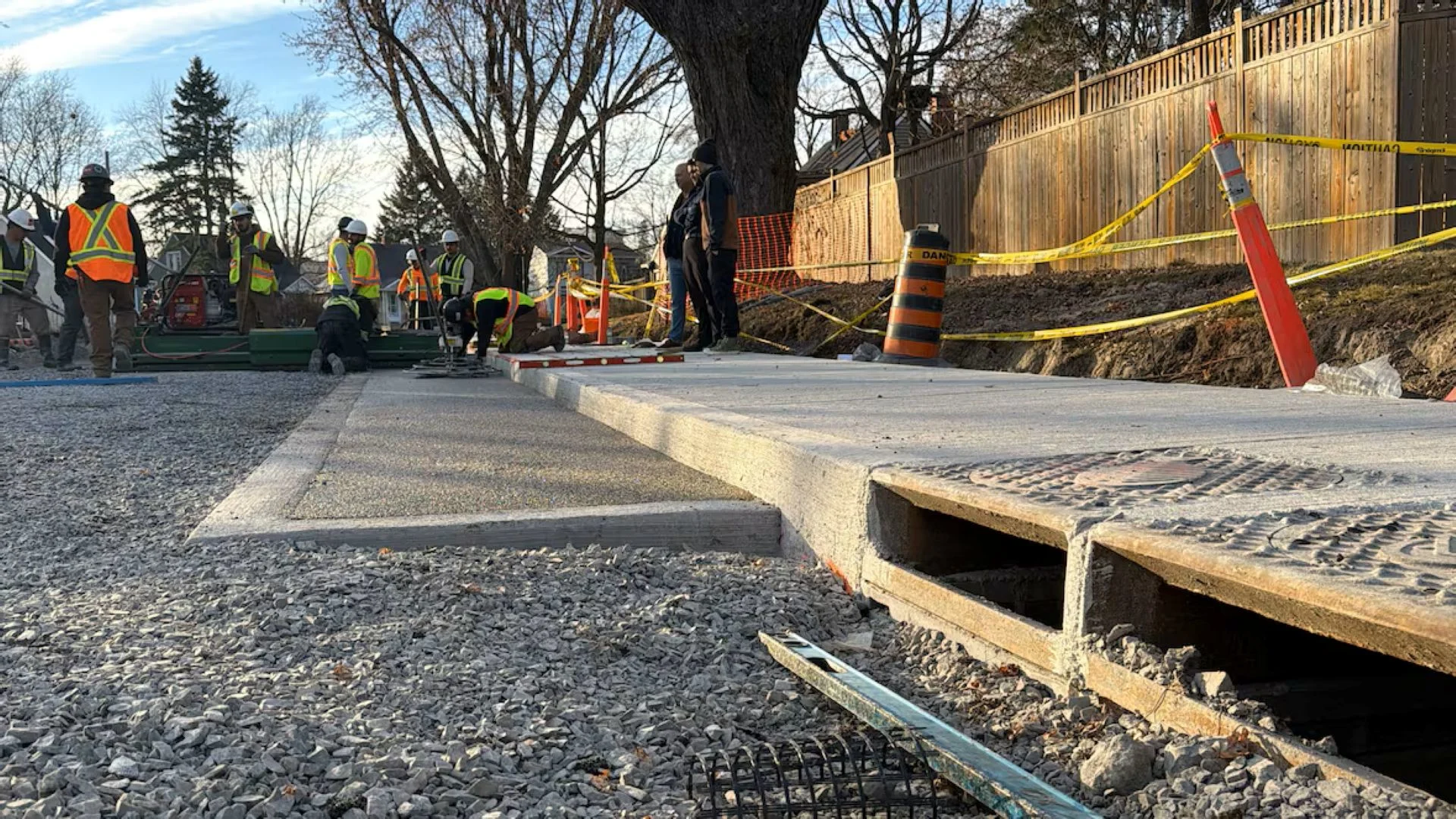
Ottawa installs first-ever permeable pavement strip after extremely wet summer

After an extremely wet summer that shattered regional rainfall records, the City of Ottawa has installed a special kind of pavement that will soak up precipitation in an area near the Central Experimental Farm.
Crews finished installing a metre-wide strip of permeable pavement at Anna Avenue and Crown Crescent on Thursday, making it the first roadway of its kind in Canada.
Unlike regular pavement, which pushes run-off towards a storm drain, the atypical asphalt acts like a sponge, sucking up rainfall and channelling it into a gravel-based drainage and storage system underneath.
The installation hugs the curb along Crown Crescent, running along two-thirds of the street.

The technology has been used in parking lots and driveways in other cities, but it was important for local developer PurePave Technologies for Ottawa to have the first roadway with permeable pavement.
"On Canada Day my house got flooded, so the problem is close to home and so is the solution," CEO Taylor Davis said.
For now, the strip is a pilot project that will determine if the approach can be scaled up as researchers keep a close eye on how much stormwater the system can hold.
Although the permeable pavement was installed in a different ward, Knoxdale-Merivale Coun. Sean Devine says he began conversations with the company back in 2024, hoping to adapt the technology for municipal use.
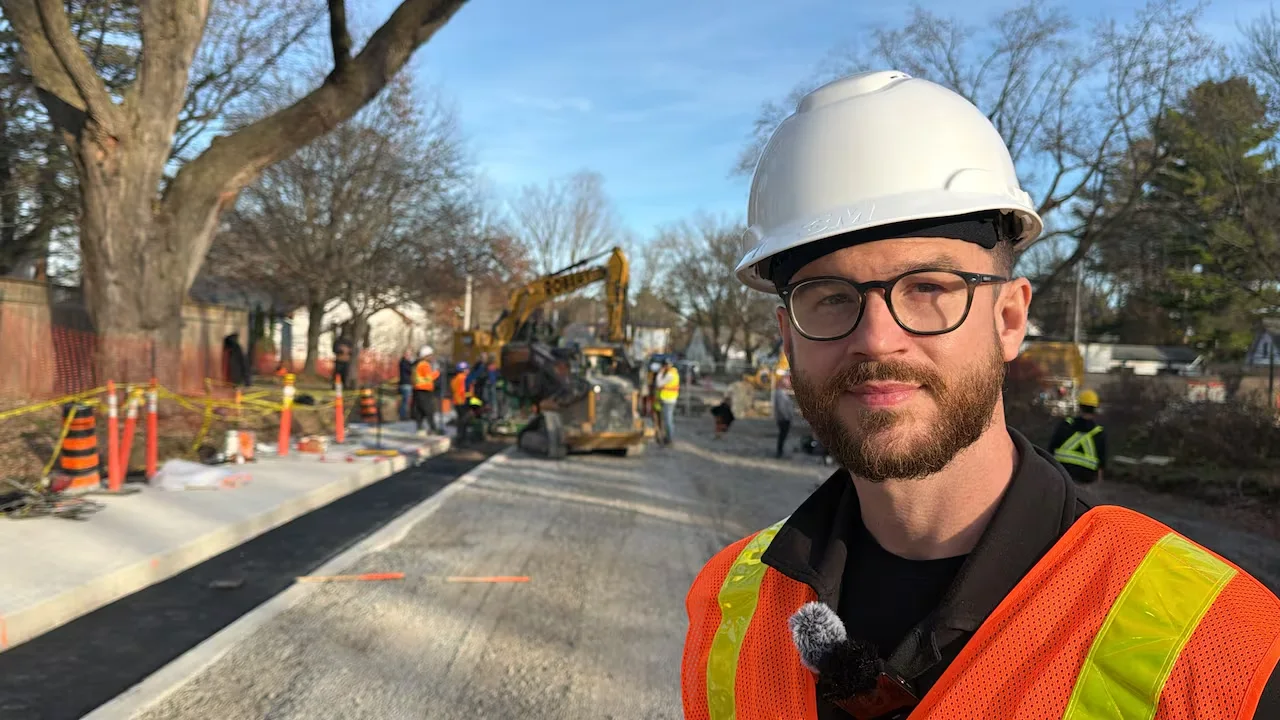
Taylor Davis is CEO of Ottawa-based PurePave Technologies, a company that specializes in developing permeable pavement. (Dan Taekema/CBC)
"We just had a pretty nasty year of flooding," he said. "One reason we have that flooding is because as our city and our population grows, we keep on paving more and more spaces with pavements that are impermeable."
The project is being supported by a partnership with the National Research Council and Carleton University, with sensors embedded into the drainage system to assess how much stormwater the permeable pavement can hold.
Devine says he's talking with city staff to find more areas around the city with flood risk that could benefit from the technology.
"We can rip up all of our sewers and make them bigger, that'll cost billions of dollars, or we can find innovative ways to handle that water," he said. "That's what we're doing right here."
Thumbnail courtesy of Dan Taekema/CBC.
The story was originally written by Justin Ball and published for CBC News. It contains files from Dan Taekema.