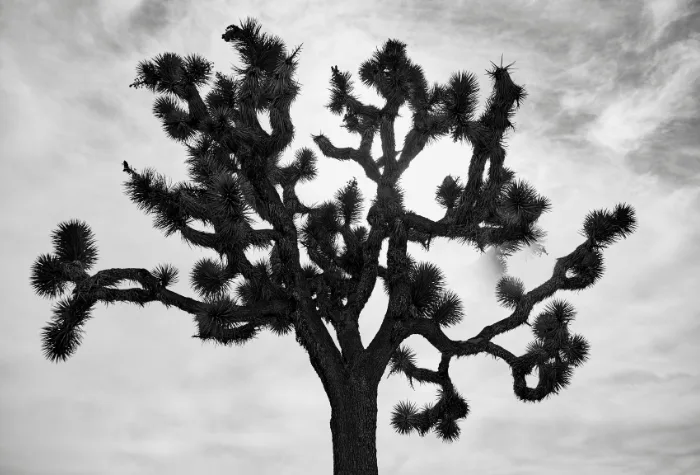
A series of events fooled Joshua trees into blooming early, and that's not good

Early blooms aren't a good thing for an already-struggling species, experts say.
In California's Joshua Tree National Park, trees typically flower in the late spring - but in November 2019, a rare event occurred.
Joshua trees and closely-related Mojave yuccas were in full bloom, months ahead of schedule.
Scientists wanted to figure out why, so they turned to citizen scientist data, detailed in a new study appearing in the Nature publication Scientific Reports.
"Little is known about which environmental conditions trigger flowering in Joshua trees, Yucca brevifolia, and Mojave yuccas, Yucca schidigera," the authors say in a statement.
"But with the advent of citizen-science platforms like iNaturalist, scientists have unlimited access to increasingly larger amounts of data that allow them to study global biodiversity patterns, for which Joshua trees are especially well-suited."
The trees in Joshua Tree National Park are a huge tourist attraction - drawing in hundreds of thousands of people each year. The fact that they're photographed frequentlymakes them a prime subject for a citizen science study, the authors say.
For their study, lead author Laura Brenskelle, a doctoral student at the Florida Museum, and her team examined over 3,000 photographs of Joshua trees and Mojave yuccas taken between 2009 and 2020, documenting when they flowered. By combining the findings with GPS and environmental data, they zoned in on which conditions most often triggered flowering.
The results?
It's complicated, the authors say. It turns out there is "no single cue" that jumpstarts the blooms. Instead, they appear to flower based on several complex interactions between temperature, precipitation, and light exposure.
Both species bloom in wet and cool conditions, providing a likely explainer for the November 2019 event.
"It was unusually cold and wet for a portion of October," study co-author Rob Guralnick, curator of biodiversity informatics at the Florida Museum, said.
Hours of daylight are about the same in the autumn and spring, so researchers think the trees were "fooled" into producing flowers ahead of schedule.
But there's more to the story, Brenskelle says. Even when all the conditions were accounted for, it remained difficult to predict the precise location of where the trees bloomed, suggesting a "subtler interplay" of factors may be in the mix than what was captured in the study's model.
BAD NEWS
Flowering ahead of the season doesn't fare well for Joshua trees because a sole species of nocturnal moth pollinates their blooms.
"One of the concerns about having these anomalous yucca blooms is whether the same conditions that caused the early flowering also signaled the appearance of adult yucca moths," Guralnick said.
"We don't think so. That's bad for the yucca, because their flowers aren't being pollinated to form fruits and seeds for the next generation of plants, and it's definitely bad for the moths."
While not yet endangered, Joshua trees are facing numerous threats, including habitat loss, wildfires, and climate change.
The study's authors hope the findings will help guide future research and policymaking, both of which can help Joshua trees survive in a future that will likely be plagued by unseasonable weather events.
"There are people who really care about our natural ecosystems, and the fact that people adore and love Joshua trees means that we have a chance to save them," Guralnick said.
"If we know enough about their biology, we have an even a better chance of making the right decisions down the road."
Thumbnail: Lercher & Johnson / Getty Images / Canva Pro