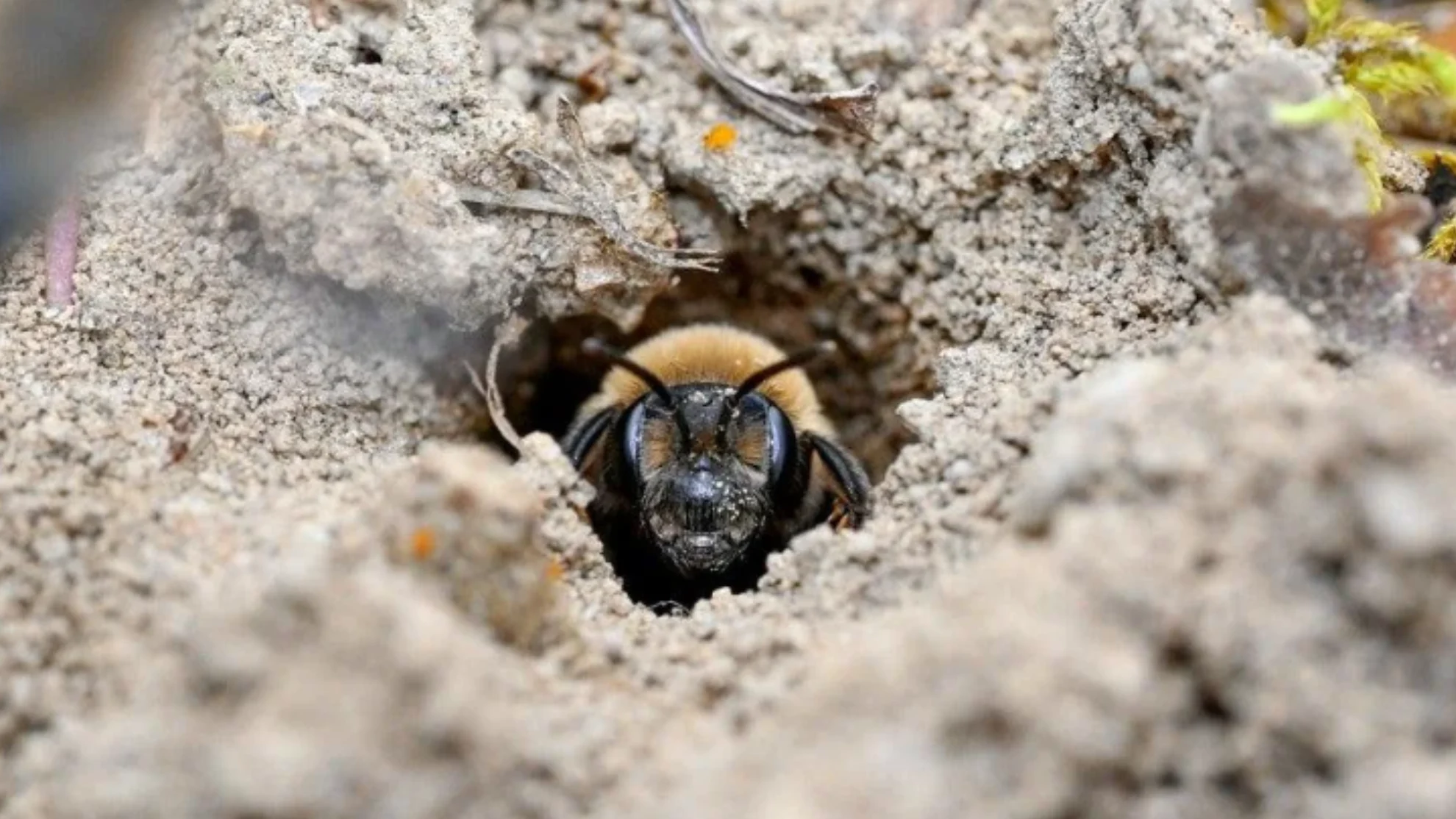
A NY cemetery has been hiding 5.5 million bees underground for a century

The bees have been present at the cemetery since the early 1900s.
In spring 2022, Rachel Fordyce walked through East Lawn Cemetery on her way to work at a Cornell entomology lab.
She noticed bees were everywhere, so she collected some in a jar and brought them to work.
They turned out to Andrena regularis, or a “regular mining bee,” a wild species of solitary bee that nests underground and serves as an important pollinator to crops and plants.
Further investigation into the cemetery revealed one of the largest and oldest known aggregations of nesting bees on record, with an estimated 5.5 million individual bees in a 1.5-acre area.
“That is comparable to more than 200 honeybee hives and exceeds Manhattan's human population by more than threefold,” Cornell University researchers say in a statement.
SEE ALSO: Want to help native bees this summer? Build them a hotel!
The findings are detailed in a paper in the journal Apidologie.
"The research elevates the value of solitary ground-nesting bees and shows just how abundant these bees are, how important they are as crop pollinators, and that we need to be aware of these nest sites and preserve them," Bryan Danforth, an author involved in the study and Fordyce’s supervisor, says.
Long-time residents
The East Lawn Cemetery dates back to 1878, but historical data suggest the bees moved into the area sometime in the early 1900s.
Between March 30 and May 16, 2023, the research team used mesh tents to collect insects in the cemetery, capturing 3,251 specimens from several species.
“A. regularis overwhelmingly dominated the samples,” the authors write.
They used the number of bees captured in traps to calculate density, with a total estimated population of 3 to 8 million bees and an average estimate of 5.5 million.
DON'T MISS: Native bee in Canada under attack from newfound invasive species
Cemeteries as habitats
The authors say the discovery demonstrates how cemeteries can act as important urban ecosystems, creating habitat for plants, birds, mammals and, in this case, bees.
This is because, compared to other public city spaces, cemeteries are quiet, infrequently visited, and usually free of pesticides.
Loving apples in the big apple
New York is the second-largest apple-producing state in the U.S., with an annual economic impact of $2.1 billion, according to a separate 2017 study from Cornell.
The bees identified in the study play an important role in keeping this industry running, overwintering underground and emerging in early spring, timed to the apple bloom.
The traps revealed that male bees appeared first during warm days in April, with females emerging a few days later.
"The males come out first and wait for the females, so that they have the best opportunities to mate and pass on their genes," lead author Steve Hoge says.
It’s suspected that Cornell Orchards, which is about 500 metres from the cemetery, may help support the bees.
Preserving bee populations
The Cornell team has launched a global citizen science initiative called Project GNBee to recruit people to report ground-nesting bee aggregations.
About 75 per cent of bee species are solitary ground nesters like A. regularis, the researchers say.
"These populations are huge, and they need protection," Danforth said. "If we don't preserve nest sites, and someone paves over them, we could lose in an instant 5.5 million bees that are important pollinators."
Header image: A Female A. regularis at nest entrance in East Lawn Cemetery. (Bryan Danforth)