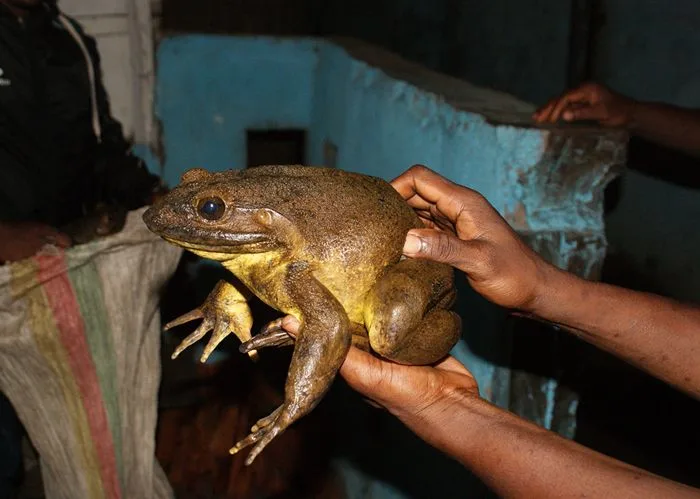
When you're a frog this big, you build your own pond
The Goliath frog lives up to its namesake, with adults growing to be nearly 35 cm long (13.4 inches) and tipping the scales at 3.3 kg (7.3 pounds). Their hefty limbs can propel them up to 3 metres (10 feet) at a leap, and researchers have now discovered the frog uses its powerful legs for more than just covering ground.
"Goliath frogs are not only huge, but our discovery shows they seem to be attentive parents as well," says Marvin Schäfer, the study's lead author.
When it comes time to reproduce, the goliath frog doesn't just choose any old pond for its young -- it makes its own.
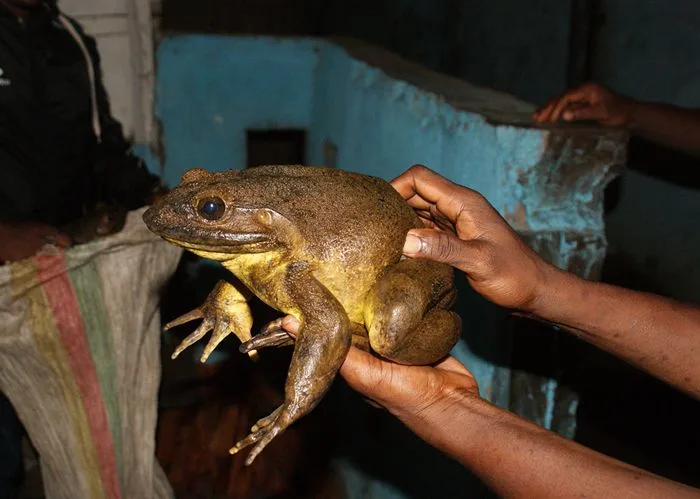
An adult Goliath Frog caught by a local froghunter in Cameroon. Image: Marvin Schäfer.
The study documents a cluster of 'nests' along the Mpoula River in western Cameroon; small ponds which were either cleared of debris or built from scratch by prospective parent frogs. Some of the frog-made ponds were larger than 1 metre (39 inches) in diameter and up to 10 cm (4 inches) deep. Several were ringed with large stones weighing up to 2 kilograms (4.4 pounds) apiece. By comparison, an adult Goliath frog moving a stone that big would be the equivalent of an average adult man lifting a 54 kilogram (121 pound) rock.
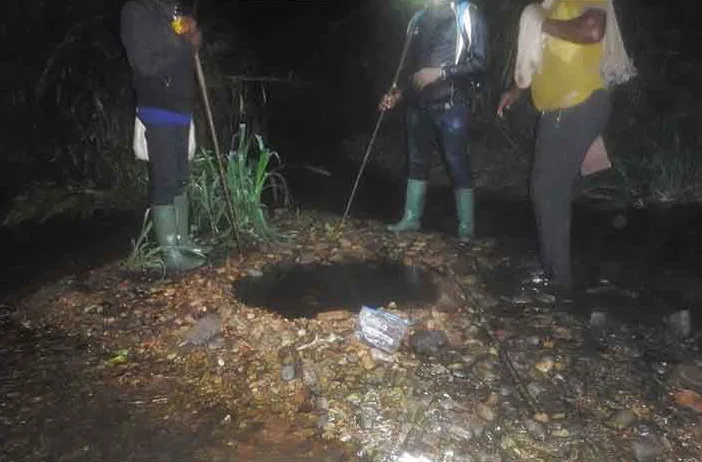
One of the types of nests. Image: Marvin Schäfer/Schäfer et al. 2019.
"Digging out a nest that exceeds 1 m in diameter and 10 cm in depth, by moving coarse gravel and stones of several kilograms, is a serious physical task," reads the study, "and suggest a potential explanation for why Goliath frogs are among the largest frogs in the world."
Oddly, whether the nests exist because the frogs are big, or the frogs or big because the nests exist is a bit of a 'chicken and the egg' question.
"The little ponds they make at the edges of fast-flowing rivers provide their eggs and tadpoles with a safe haven from sometimes torrential waters, as well as from the many predators living there," says Schäfer. "We think that the heavy work they put into excavation and moving rocks may explain why gigantism evolved in these frogs in the first place."
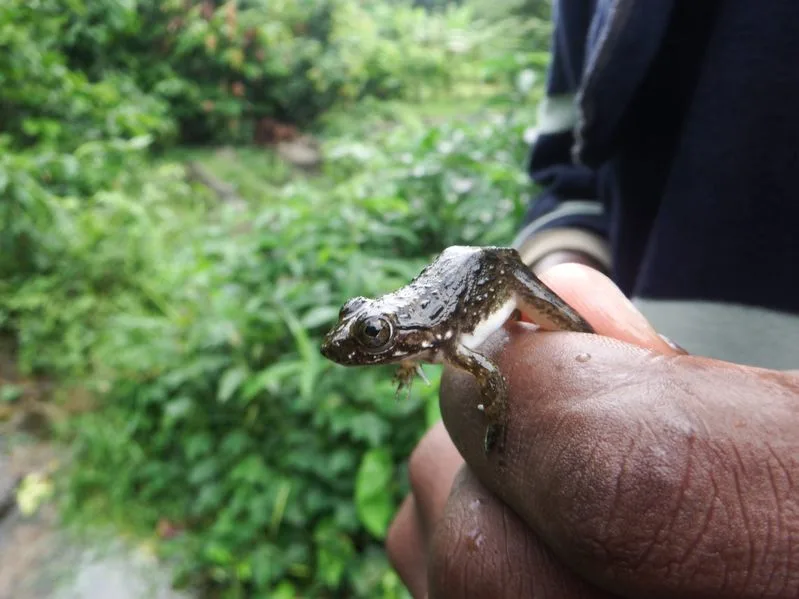
Recently metamorphed juvenile frog, often found in vegetation near nesting sites, indicating they stay around their nursery for some time. Image: Marvin Schäfer.
Because the frogs don't just build the nests; they stand watch over their eggs and tadpoles at night, keeping predators at bay providing an extra layer of protection for their young. It's not clear how the division of labour works, though local hunters speculated to the team that it was the males who did the building and the females who took up guard duty.
If the species relies on this method to protect its young -- building sheltered nests and then actively guarding them -- it makes sense that the biggest and strongest would have the evolutionary advantage.
If nothing else, they make good inspiration for never skipping leg day at the gym.
Thumbnail: Marvin Schäfer
Sources: EurekaAlert | Journal of Natural History | Popular Science | IFLScience |