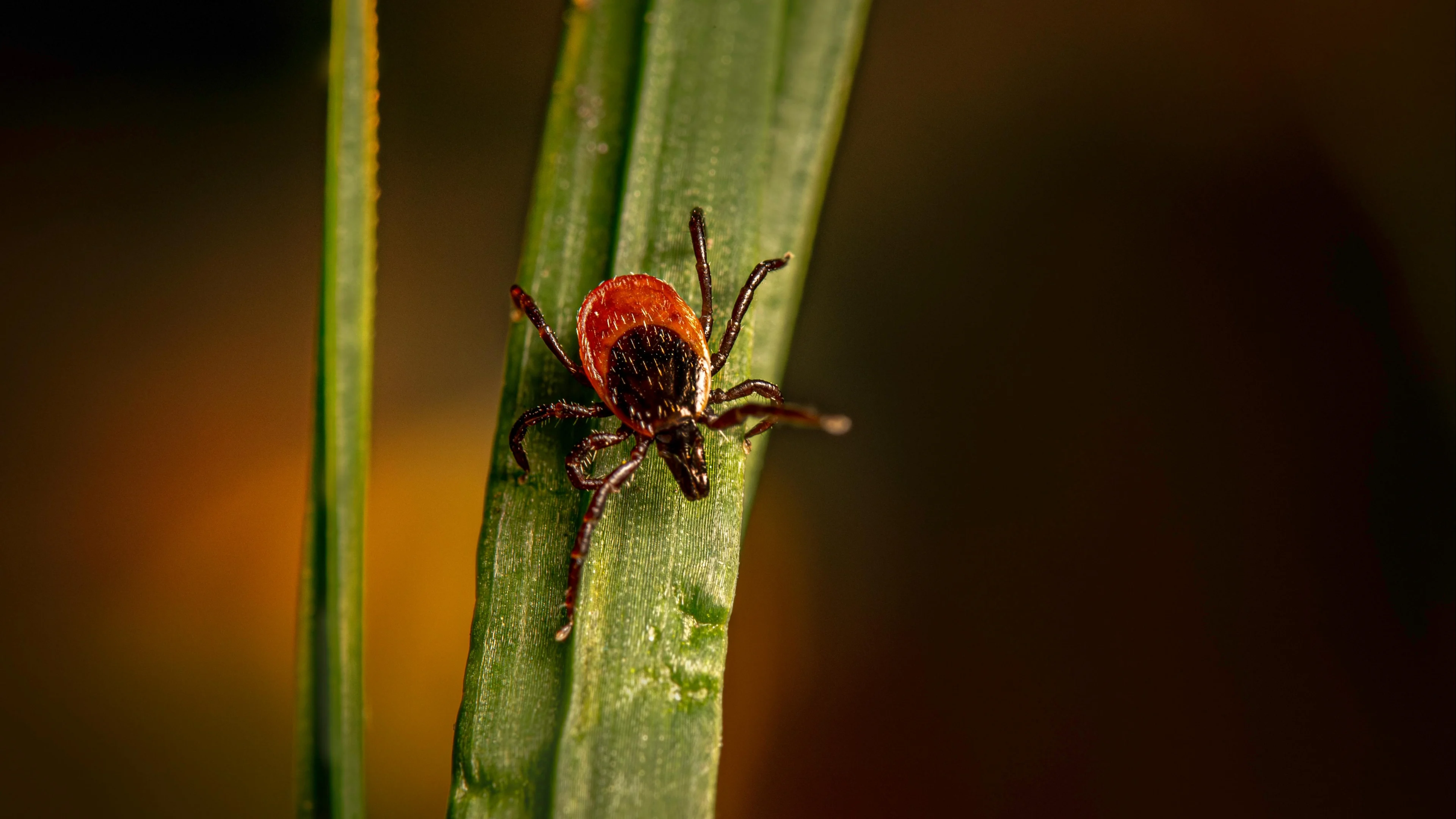
Woodchips on trails reduce tick populations, Ottawa researchers find

Applying woodchips to trails in the woods can significantly reduce local tick populations, a study published this month by researchers at the University of Ottawa has found.
The study suggests that a relatively low-tech solution could reduce the incidence tick bites — and the associated risk of Lyme disease — for walkers in the woods.
The team chose two sites in Ottawa's Greenbelt: the Mer Bleue sector in the east and the Stony Swamp sector in the west.
On 20 sections of trail, each 50 metres long, the team applied either untreated woodchips or woodchips treated with the pesticide deltamethrin.

Ticks and tick-borne diseases. (Gabrielle Huston/CBC)
Where the untreated woodchips were used, the number of ticks was reduced by about half, and where woodchips treated with the pesticide were used, the number of ticks were reduced by 99 per cent, according to Katarina Ost, a researcher on the team.
"So we did learn a few valuable lessons from this," she told CBC Radio's Ottawa Morning.
Why woodchips work
Woodchips work to deter ticks because the tiny parasitic arachnids often climb vegetation (like grass) to latch onto hikers or their pets, Ost explained. Placing woodchips on the trail prevents the vegetation they need to climb from growing.
"You definitely need a certain type of trail," Ost added.
"Those really wide, high use trails with high tick density are pretty suitable options for rolling this out in a slightly larger scale."

Katarina Ost is a PhD in epidemiology on the faculty of medicine at the University of Ottawa. (Submitted by Katarina Ost)
With that in mind, she said it "wasn't super surprising" that the pesticide would have an even larger impact. Deltamethrin doesn't pose a danger to pets who might walk on the wood chips, she explained, because the pesticide "doesn't move much" once it adheres to a surface.
When it comes to preventing tick bites in your own backyard, one step the federal government suggests is a border of wood chips, mulch or gravel around your lawn to "create an environment where ticks can't survive."
Controlling the critters at their source is the best way to limit the spread of any infection spread by bugs, said Dr. Christopher Labos, a cardiologist and epidemiologist at McGill University.
"That is fundamentally why we don't talk about malaria in North America anymore, because we have controlled the insect population," he said, adding that this study shows one possible way to reduce the number of ticks that people come into contact with.
But he also noted that the woodchips only work if people stay on the path.
"One would hope that the people who are going off the path like this are probably knowledgeable enough about tick-borne diseases that they would be following standard precautions like wearing long pants, using insect repellent, and just being careful to do a tick check after the fact," Labos said.

Dr. Christopher Labos says controlling ticks at their source is the best way to limit the spread of tick-borne diseases. (CBC)
Further studies could establish whether reducing the number of ticks in these areas had a direct correlation with reducing Lyme disease, Labos said.
"It's all well and good to decrease the number of ticks, but if Lyme disease cases don't change, then you haven't really accomplished anything, medically," he said.
"It is, I think, reasonable and understandable to assume that without any ticks around, you're not going to get Lyme disease, but it still would be nice to actually prove that point."
Thumbnail courtesy of Erik Karits/Pexels.
The story was originally written by Gabrielle Huston and published for CBC News. It contains files from CBC Radio's Ottawa Morning.