What Winnipeggers can do if they encounter a coyote

Richard Peters was walking his dogs in Winnipeg on Monday night when he came across a coyote.
He noticed it following him and his Jack Russell terriers while they were out for a walk in North Kildonan, near the Perimeter Highway.
"At first I thought, is this a dog or a coyote? So I looked around for an owner, because it looked sleek, with great fur, bushy tail," Peters told CBC Manitoba Information Radio host Marcy Markusa. "Like a rescue that we can often see."
Peters wasn't worried for himself, but he was scared for his two small dogs.
SEE ALSO: Here's how to safely coexist with coyotes this spring
"It was looking more at my dogs than at me — completely unafraid, almost fox-like in its curiosity," Peters said.
"As we continue to look at each other, it sat down and then I snapped a picture of it and eventually it just kind of laid down."
The number of reported coyote sightings has remained stable in recent years, but Winnipeggers may see coyotes more often in spring for a number of reasons, including because they could be caring for pups, said Janine Wilmot, a human-wildlife coexistence biologist with Manitoba Natural Resources who offered tips for dealing with coyote encounters.
Peters' coyote encounter echoes other reports that get sent to the Natural Resources and Northern Development office, Wilmot said.
Most coyote reports in the city involve the presence of a pet dog, with the coyotes more interested in the pet than the human, she said.
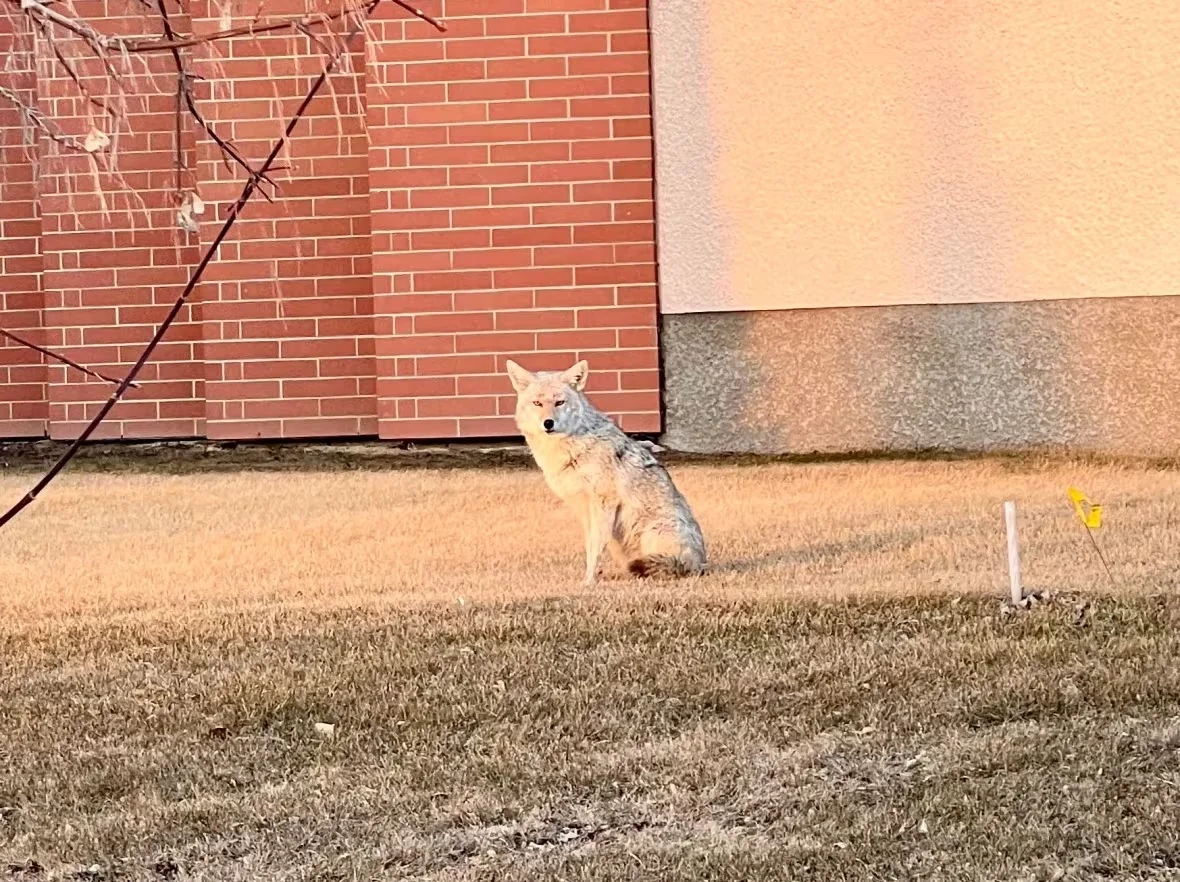
Winnipegger Richard Peters encountered this coyote while walking his dogs in North Kildonan on Monday evening. (Submitted by Richard Peters)
"They try and avoid encounters with people. They tend to be a very wary animal," Wilmot said.
Typically, they will follow dog walkers as a way to keep an eye on the dogs, which they see as potential threats to their territory because they are also canines.
Essentially, coyotes perceive dogs as competitors who can steal food and other resources, Wilmot said.
"They're not aware of the fact that our domestic dogs get their food from the grocery store, of course, so they want to protect their food resources in the area."
It is important to keep pets on a leash to reduce the risk of an attack, Wilmot said.
Winnipeggers who walk at night are more likely to have close encounters. Coyotes are afraid of humans, and as a result, have shifted to nocturnal behaviour to avoid people, Wilmot said.
If a coyote approaches you, become "large and loud" to deter it, a practice known as hazing.
Examples of hazing include raising a jacket above your head to appear larger and shouting. Carrying pebbles in a canister or a safety whistle give you another option for creating noise.
Wilmot warns against running away, as that can result in the coyote chasing you.
WATCH: Hazing project wants to keep urban coyotes from Edmonton streets
Peters' sighting happened in North Kildonan, but there have been coyote sightings all over the city, with the number of sightings fluctuating within different parts of the city, she said.
The coyote Peters saw did not attack him or his dogs, which were on a leash. One of his dogs is outgoing and without a leash may have tried to play with the coyote, Peters said.
Winnipeggers can report coyote sightings to conservation officers by calling 204-945-5221.
Thumbnail courtesy of Bryce Hoye/CBC.
The story, written by Chidi Ekuma, was originally published for CBC News. It contains files from Wendy Parker.