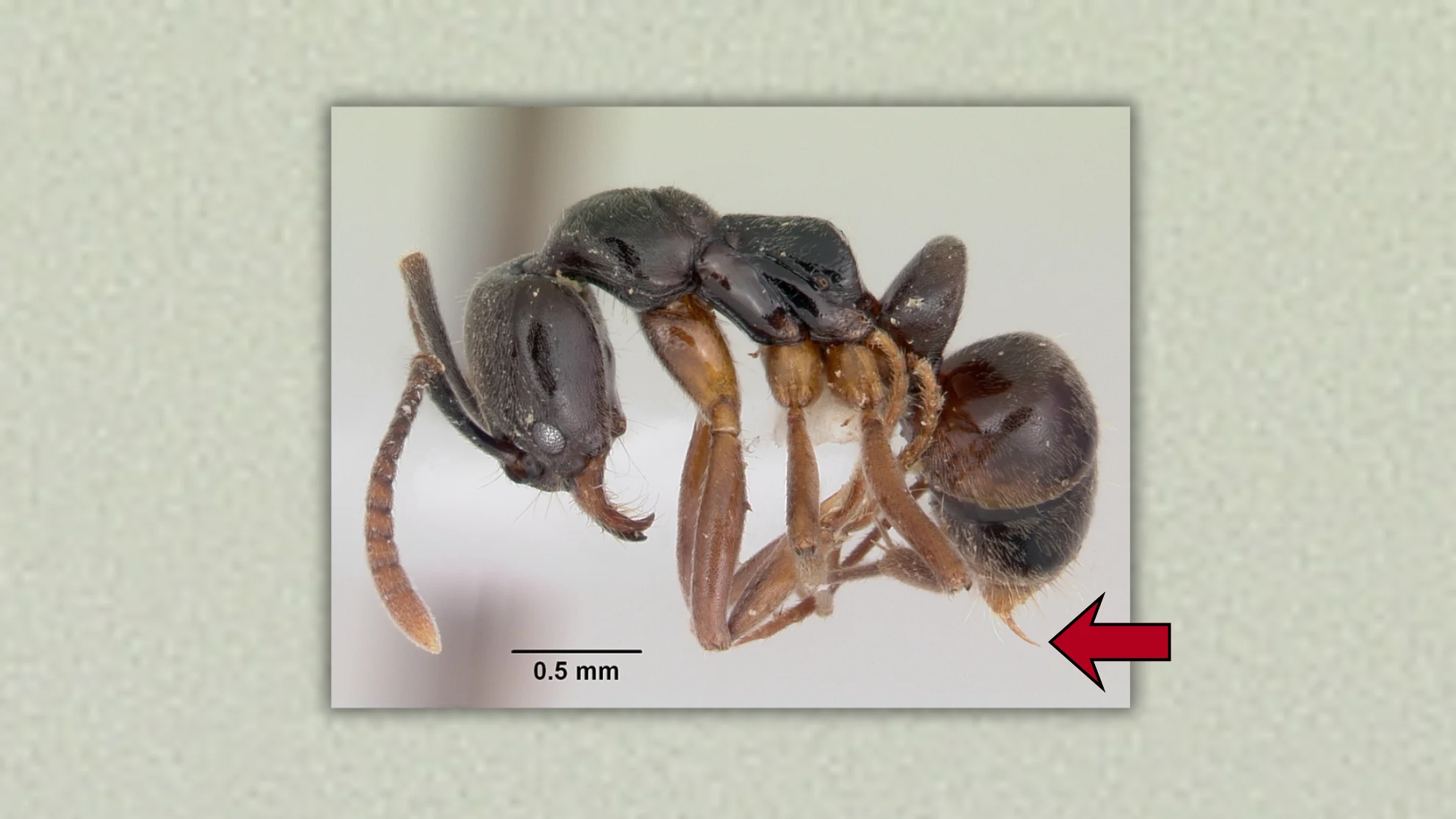
Warm weather helps invasive ant with life-threatening sting spread north

“Unfortunately, as with many invasive species, it appears Asian needle ants are here to stay.”
Increasingly warmer daily highs and extended warm seasons are helping a toxic ant spread northward into Washington and the Pacific Northwest, according to recent media reports.
Considered “highly invasive,” the Asian needle ant is moving quickly in the U.S., with at least 20 states on alert due to the species’ potentially life-threatening sting.
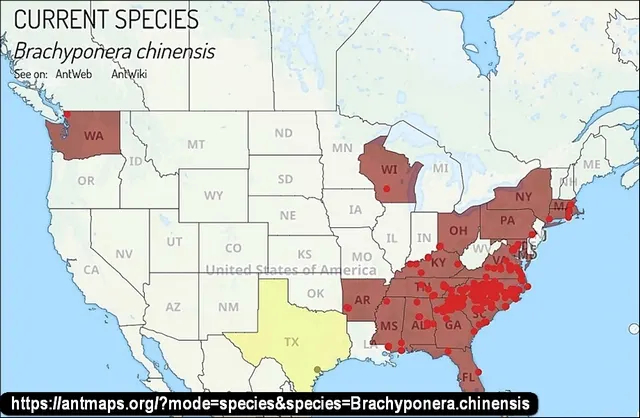
Asian needle ant spread in the U.S. (antmaps.org via OSU)
What is the Asian needle ant?
Originally from China, Japan, and the Koreas, the ant was first detected in the U.S. in 1932, but it is becoming an increasing problem as warmer temperatures help extend its range.
It is small — only about 0.5 cm in length — and can be dark brown or black with orange-brown legs.
According to the USDA, you can find the ant under stones, logs, or leaf litter in undisturbed forest. In human-populated zones, they tend to congregate near homes and businesses in sheltered spaces like mulch and landscape timber.
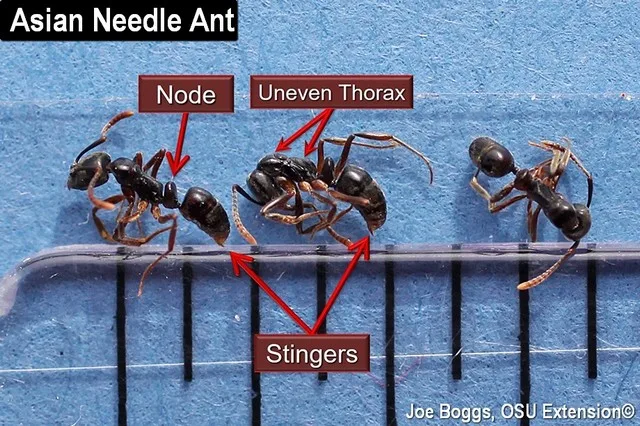
Joe Boggs/OSU
The environmental impact of the Asian needle ant
The USDA says the ants can negatively impact local ecosystems by displacing native ants and other species that act as seed dispersers.
“Many herbaceous plants’ seeds have a nutritious structure attached called an eliasome, which attracts certain ants,” the agency writes.
“These ant species, many in the genus Aphaenogaster in the U.S. East, carry the seeds away from the mother plant, ensuring proper dispersal of the plant species. Researchers have demonstrated substantial decreases in seed dispersal where Asian needle ants have invaded forest areas.”
Once established, the ant is difficult to eradicate. Research into the impact of the species on the environment, on people, and on animals is ongoing.
“Unfortunately, as with many invasive species, it appears Asian needle ants are here to stay,” the USDA writes.
A (potentially) deadly sting
Asian needle ants will sting when threatened, which can trigger severe allergic reactions, including life-threatening anaphylaxis.
Speaking with the New York Post, Benoit Guénard, an entomology professor at the University of Hong Kong who studied the ants, called its sting “excruciating.”
“It’s a very sharp, acute pain, but it’s quite local,” he said.
Symptoms include:
Low blood pressure.
Hives, swelling, or itching.
Difficulty breathing.
Nausea.
A weak or rapid pulse.
If you suspect you have been stung by an Asian needle ant seek immediate medical attention, even if symptoms are not yet present.
Three people in the U.S. state of Georgia died in 2024 from anaphylaxis after being stung by the ant, which has a stinger sharp enough to pierce clothing, the New York Post reports.
Experts say the best course of action is to avoid the ants entirely.
One silver lining: Asian needle ants do not swarm and attack like some other species.
Andrew Johnston, an insect diagnostician at Purdue University’s Department of Entomology, told the New York Post that gardeners should wear thick gloves and “pay attention” to what they are grabbing.
Are Asian needle ants in Canada?
As spring temperatures climb, scientists say warmer conditions can help some invasive species expand farther north — a trend Canadian authorities are watching closely.
Currently, there are no reports of Asian needle ants in Canada.
However, they have recently been detected in neighbouring Washington State.
Officials in B.C. have posted alerts on the possibility of the ants moving into the province, citing climate warming as a factor that could help them expand into Canada.
Header image: April Nobile/Wikipedia CC BY 4.0