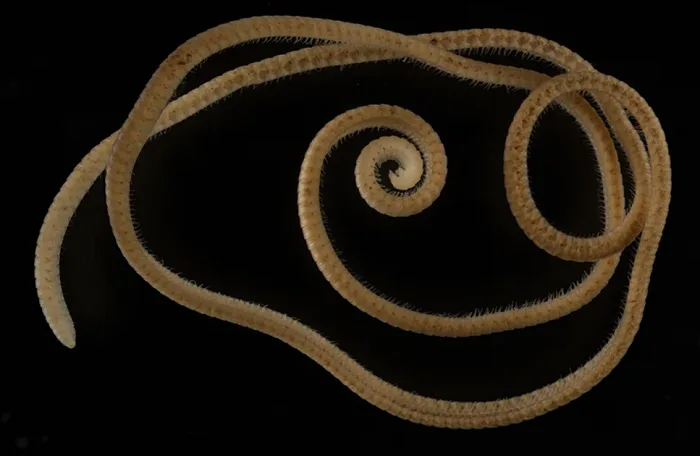
The first 'true' millipede with 1,306 legs has been found

Researchers say there may be more undiscovered creatures in the area.
A new species of millipede has been discovered 60 metres underground in a mining hole in Australia's Eastern Goldfields province.
It has 1,306 legs and can measure up to 96 mm in length. It has been named Eumillipes persephone. "Eumillipes" translates into "true-thousand-foot" and "persephone" is a nod to the Greek goddess of the underworld.
Unlike the name may suggest, most millipedes don't have 1,000 legs. There are about 7,000 species worldwide, and the number ranges from anywhere between 24 and 750 legs. E. persephone marks the first "true" millipede ever found, i.e., one with more than 1,000 legs.
The discovery, made in August 2020, is detailed in a new paper appearing in the Nature publication Scientific Reports.
E. persephone has up to 330 segments on its body and can measure up to 96 mm in length. It has a cone-shaped head with antennae, a beak for feeding, and no eyes.
Scientists think E. persephone is a distant relative to Illacme plenipes, the previous record-holder of most legs, with 750 appendages.
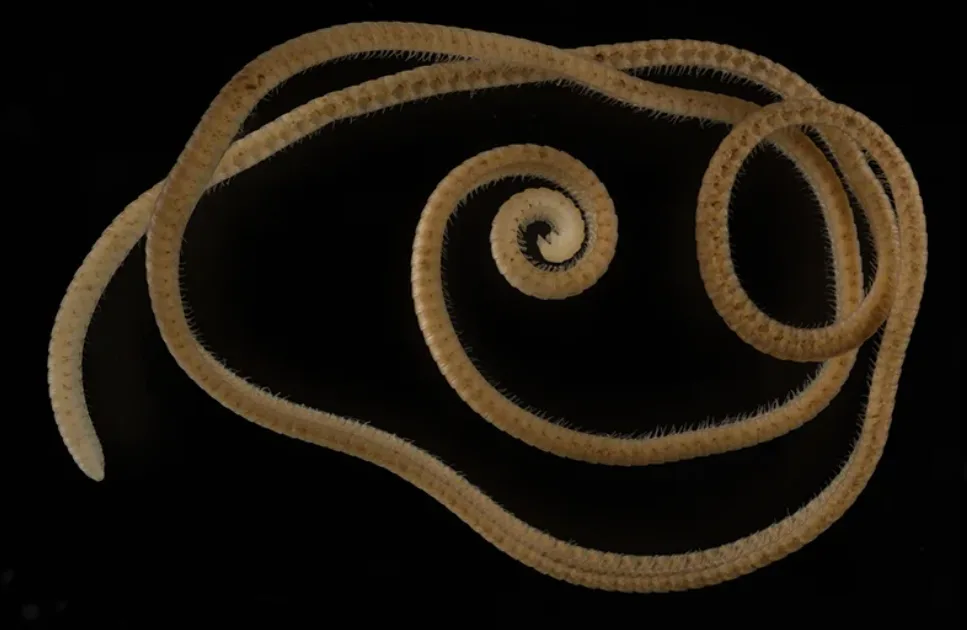
Eumillipes persephone, a.k.a. "the leggiest animal on the planet," according to researchers. (Marek et al, Scientific Reports 2021).
THE WONDERFUL UNDERGROUND
"Among the earliest animals to breathe atmospheric oxygen and with some extinct species that grew to two meters in length, millipedes have lived on this planet for more than 400 million years," the authors write in their paper.
There's still a lot to be discovered deep underground, researchers say. Conditions have changed above ground over the millennia, but below, the environment was probably cool and moist the whole time.
Locator map showing where the millipede was discovered. GIF created by April Walker.
The theory creates the possibility there are more undiscovered creatures underground in that region of Australia.
"These underground habitats, and their inhabitants, are critically understudied," the authors write.
Millipedes play an important role in the environment, helping break down matter to aid in decomposition.