Invasive jellyfish are “silently invading” freshwater lakes in Canada

Experts say increased public awareness could help mitigation efforts.
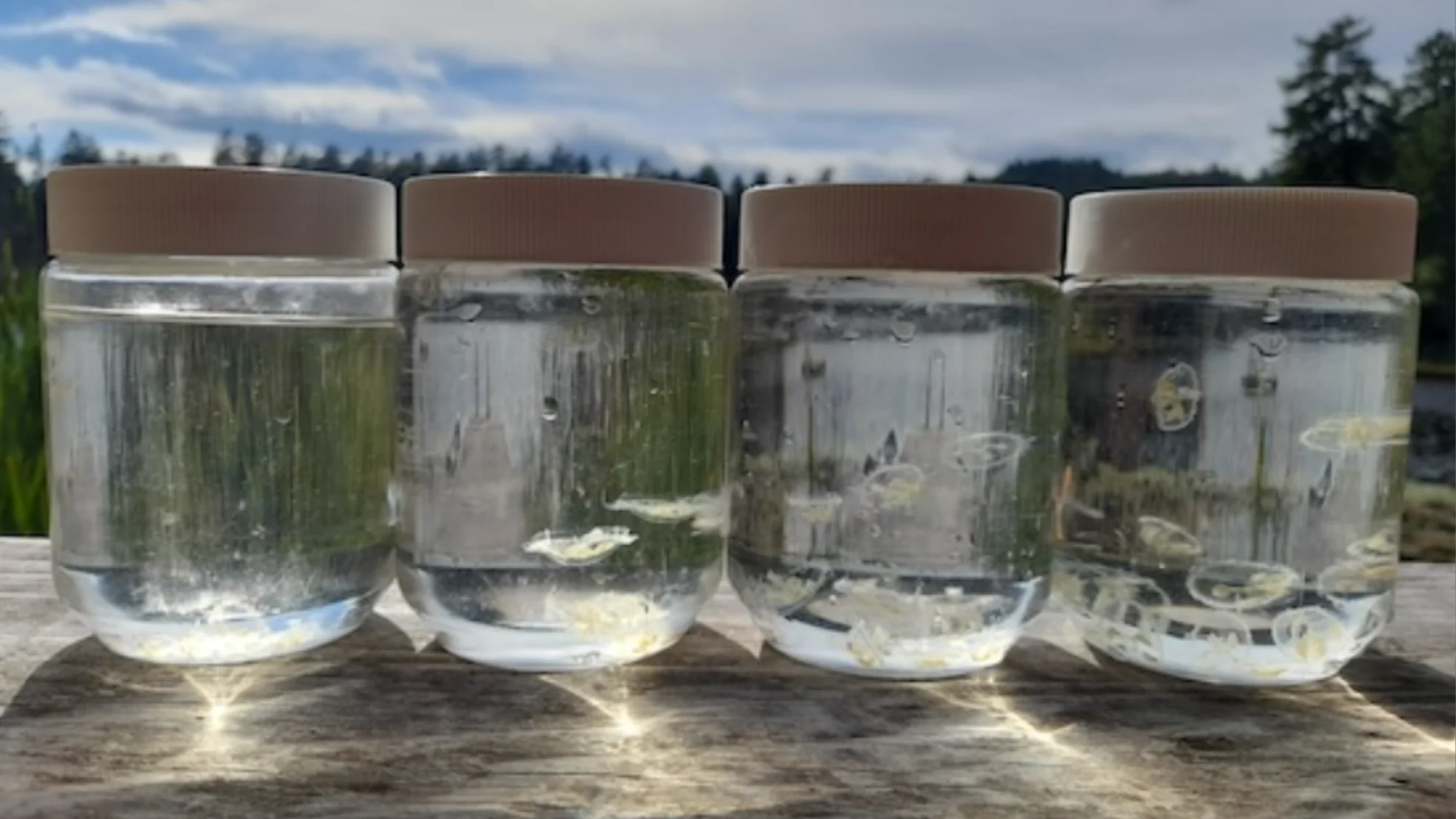
Once confined to China, the freshwater jellyfish Craspedacusta sowerbii, also known as the peach blossom jellyfish, has spread to six continents, where it is “silently invading” freshwater lakes — including those in Canada.
New research on the species’ quiet spread suggests it is being driven by several factors, including a lack of public awareness.
For starters, it is small -- usually no larger than a quarter -- and translucent, making it difficult to spot except during occasional summer “blooms,” when the jellyfish appear in large numbers during the warmer months.
Not dangerous, ecological impact unclear
Unlike other invasive species, the impact of C. sowerbii appears to be relatively subtle. While it can outcompete some native organisms for food, the jellyfish are not considered as ecologically or economically devastating as other invasive aquatic species.
Another reason it has largely gone unnoticed by the public: It is not considered dangerous to humans, with stingers designed to target much smaller prey.
How did the jellyfish spread?
Experts believe the jellyfish spread mostly by accident, hitching rides on ornamental aquatic plants and in shipping containers.
In its polyp and podocyst life stages, it is resilient and tiny, measuring only about a millimetre, allowing it to travel long distances on bird feathers, boating equipment, and aquatic vegetation.

C. sowerbii in a farm pond in Upstate New York in 2010.(J. Micheal Tracy/Wikipedia CC BY 2.0)
Study highlights a lack of public awareness
The recent study, conducted by an international team of researchers to gauge public awareness, included a multilingual survey across 17 European countries over 22 months, collecting 1,388 responses.
“The results highlight a profound lack of recognition,” the authors write in a statement.
“Over 80 per cent of respondents did not know the species’ scientific name, and only 10 per cent could correctly identify it as C. sowerbii.”
Nearly half of the respondents incorrectly believed they had observed the species in the ocean, despite it being a freshwater jellyfish.
“Researchers suggest this ‘taxonomic confusion’ stems from a bias toward marine jellyfish frequently portrayed in the media,” the authors write.
“This lack of awareness classifies the invader as ‘cryptic’, progressing silently through a life cycle that is difficult to observe, while its appearances remain sporadic.”
While the study focuses on European respondents, the findings are applicable to Canada, where scientists often rely on reports from citizen scientists to identify invasive species. The authors argue that increased public awareness could be an important mitigation tool in monitoring and slowing the spread of C. sowerbii.
Freshwater jellyfish are already present in Canada
Scientists are increasingly paying attention to the seemingly “invisible” spread of C. sowerbii and other invasive species that may fly under the radar as warming water temperatures allow some organisms to expand their range.
“There is anecdotal evidence that the invasive jellyfish had been present in British Columbia lakes and ponds for decades. Still, compiled data suggest that the number of sightings has increased considerably since the year 2000,” Florian Lüskow, a postdoctoral research fellow in the Faculty of Science at the University of British Columbia who was involved in the recent European study, wrote in 2023.
“Unfortunately, however, we still have very limited information about the range of its presence in Canada, how it got here, how it spreads, and what its essential impact on freshwater ecosystems across Canada may be.”
To date, the species has been reported in B.C., Alberta, Ontario, Quebec, and New Brunswick, normally seen in closed environments like lakes, ponds and quarries.
“It is especially interesting to study freshwater jellyfish here [in B.C.], as 50°N currently marks their northernmost distribution range in North America," Lüskow told the The Invasive Species Council of B.C.
"We can expect them to show up in new sites and build up larger populations that eventually will persist longer in the season. With this, their impact on food webs and nutrient cycles will increase.”
The authors of the European report are urging governments to integrate the “invisible” spread of invasive species into future mitigation efforts.
“By empowering citizens to report sightings through citizen science platforms, researchers can fill critical data gaps and create a more inclusive, responsive monitoring system for the subtle ecological signals of global change,” the authors say.
Header image: UBC/Florian Luskow.