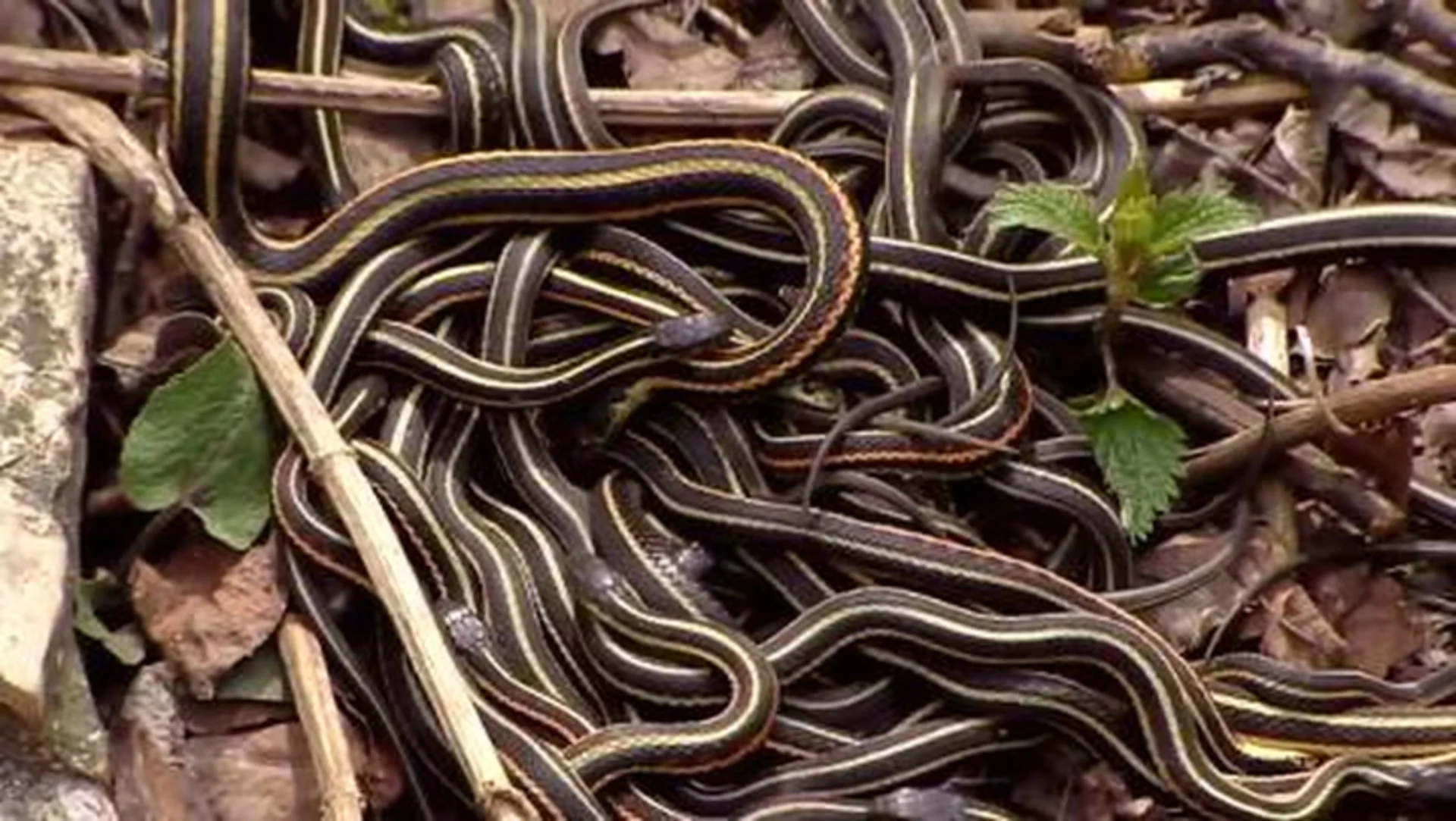
Manitoba’s snake pits are alive, caution not to crush them

An Interlake resident says hundreds of garter snakes are at risk of being crushed every year as they leave a den surrounded by trails frequently used by off-road vehicles.
An online petition signed by more than 600 people as of Thursday calls on the Rural Municipality of Gimli's mayor and council to allow a permanent barricade to be set up around the den, which is on industrial land owned by the municipality.
Potentially thousands of snakes emerge from the den every spring to mate, leaving the area to feed in the summer before returning to hibernate in the fall.
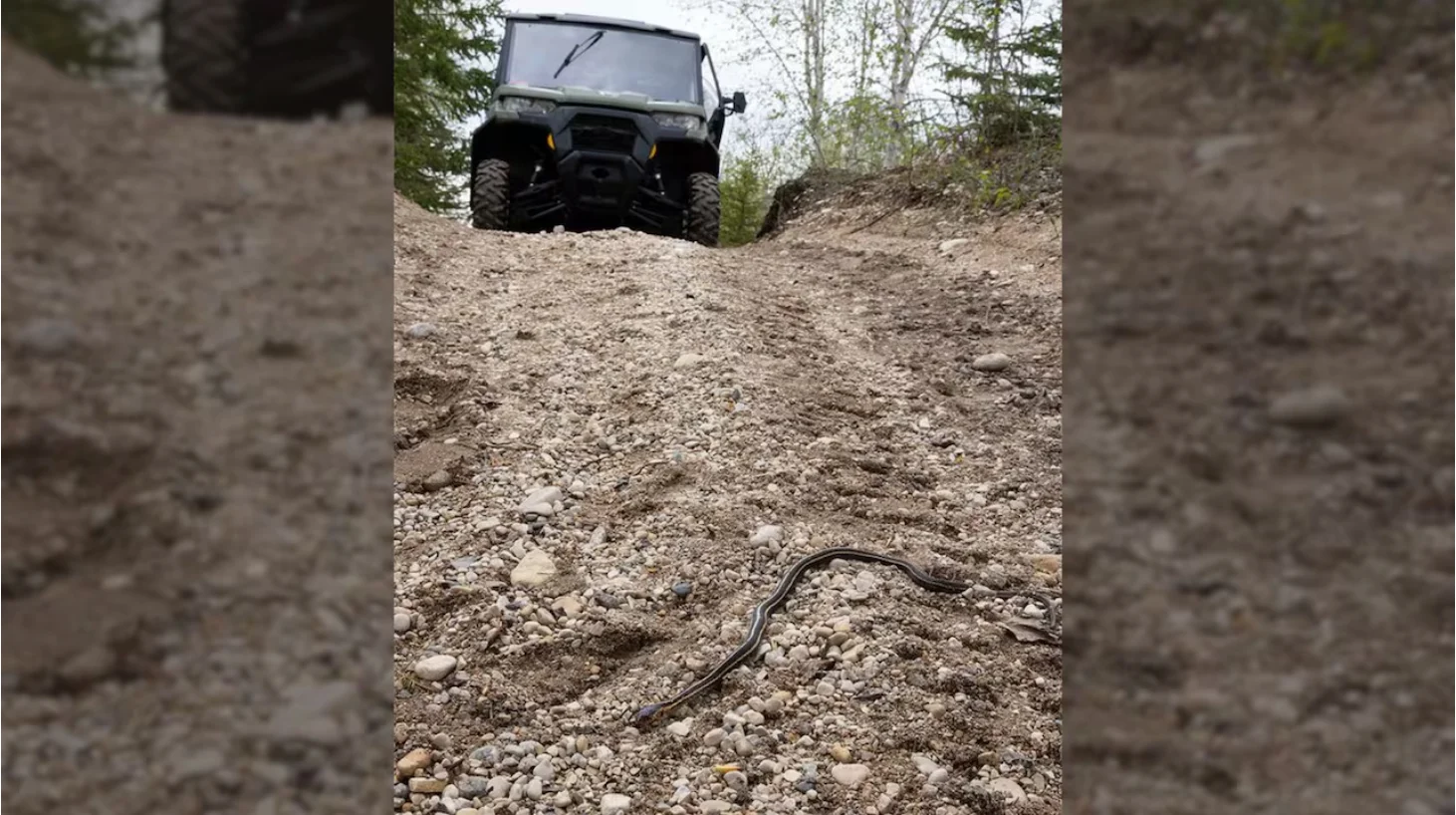
Roberta Olenick, who started the petition, took this photo in 2022. The All-Terrain Vehicle Association of Manitoba says clubs have been trying to stop people from driving in non-designated pathways. (Roberta Olenick via CBC)
SEE ALSO: Eyes out for Ontario's only venomous snake: Massasauga rattlesnake
Rural municipality of Armstrong resident Tammy Skogan said she's seen several dead snakes lying along the trail in the years since she stumbled upon the Gimli den during a nature walk with her son.
"It's very obvious that most of them are run over, are stepped on," she said. "It's very hard to watch when you love nature."
The den is in a slope about six metres tall, with trails running along the top and bottom. Advocates say the roads are popular among all-terrain vehicle, utility-terrain vehicle and dirt bike users.
Skogan said locals have tried to put up makeshift barriers to try to prevent others from driving over the snakes.
Jackie Funk of the All-Terrain Vehicle Association of Manitoba said in an email Thursday that clubs have been putting up barriers to prevent people from driving in the non-designated pathways.
"The ATVMB clubs' trails are not located in the area of concern, but out of respect for nature, they have been trying to stop others from riding in sensitive areas," Funk said.
RELATED: Manitoba’s snake pits are alive, and they’re the largest in the world
But Skogan said any barrier is "moved right away." A temporary one set up by conservation officers ahead of the snakes' emergence this spring was already down by the time she visited the site earlier this month, she said.
"They were snipped off within days of them being installed," Skogan said.
Roberta Olenick, a Vancouver-based zoologist and wildlife photographer, started the online petition and also held a presentation on the issue for Gimli's council last fall.
She said unlike the famous dens in Narcisse, there is no one posted around the Gimli site to ensure people don't harm or harass snakes while they emerge or return to their winter abode.
Olenick said the Narcisse dens in the Armstrong municipality, which host the largest snake gathering in the world — are deep limestone pits, which make them more difficult to access than the Gimli slope.
"It's a very confined space. You couldn't have a whole lot of people visiting it without stepping on and crowding out snakes," she said.
"The configuration of the den is such [that ATVs] can come over a hill, and suddenly they're on top of snakes before they even know they're there."
Olenick, who's originally from Manitoba, began advocating for the den after she visited to photograph the snakes in 2022. She said she saw dozens of animals whose heads had been smashed.
"Some were still alive and struggling, with their mangled heads and bloodied eyes," Olenick said. "It was heartbreaking."
She has proposed putting up a permanent barrier made of tall wooden posts placed at intervals around the den.
"There'd be no wires or mesh or anything to entangle wildlife. It would allow the local people who are used to checking on the den to walk through and have a look. But it would prevent vehicle traffic," Olenick said.
The Gimli municipality said in a statement Thursday it's looking to arrange an on-site visit with a snake biologist to determine "practical, low impact-measures" to protect the snakes.
Olenick said Gimli officials recently floated a proposal to build a berm out of rocks and gravel on the site.
She said she's concerned that kind of barrier could cast shadows, limiting the reptiles' ability to bask in the sun, with construction also potentially disrupting the den if it happens while the snakes are there.
"Snakes are very vulnerable to vibration," Olenick said. "They feel it all along their bellies, and that's how they detect a lot of what's going on in their environment. So loud, extensive vibration of machinery near the den while they're present is a bad idea."
Skogan said berms would "just be big hills for the ATVs to drive over."
She said she recently proposed planting trees that would act as barriers, adding many people like herself would be "willing to do it for free."
"I don't think the RM [is] looking at this" from a conservation perspective, Skogan said, adding she's concerned council is prioritizing the interests of off-road vehicle drivers.
"Tourism supports the Gimli community, but ecotourism could also equally do that," she said.
Gimli said no final decision has been made and that its goal is to "take a thoughtful, informed" approach that considers ecological protections and community use.
WATCH BELOW: Not all snakes are scary, some are even good for your garden
This article, written by Arturo Chang, was originally published for CBC News.