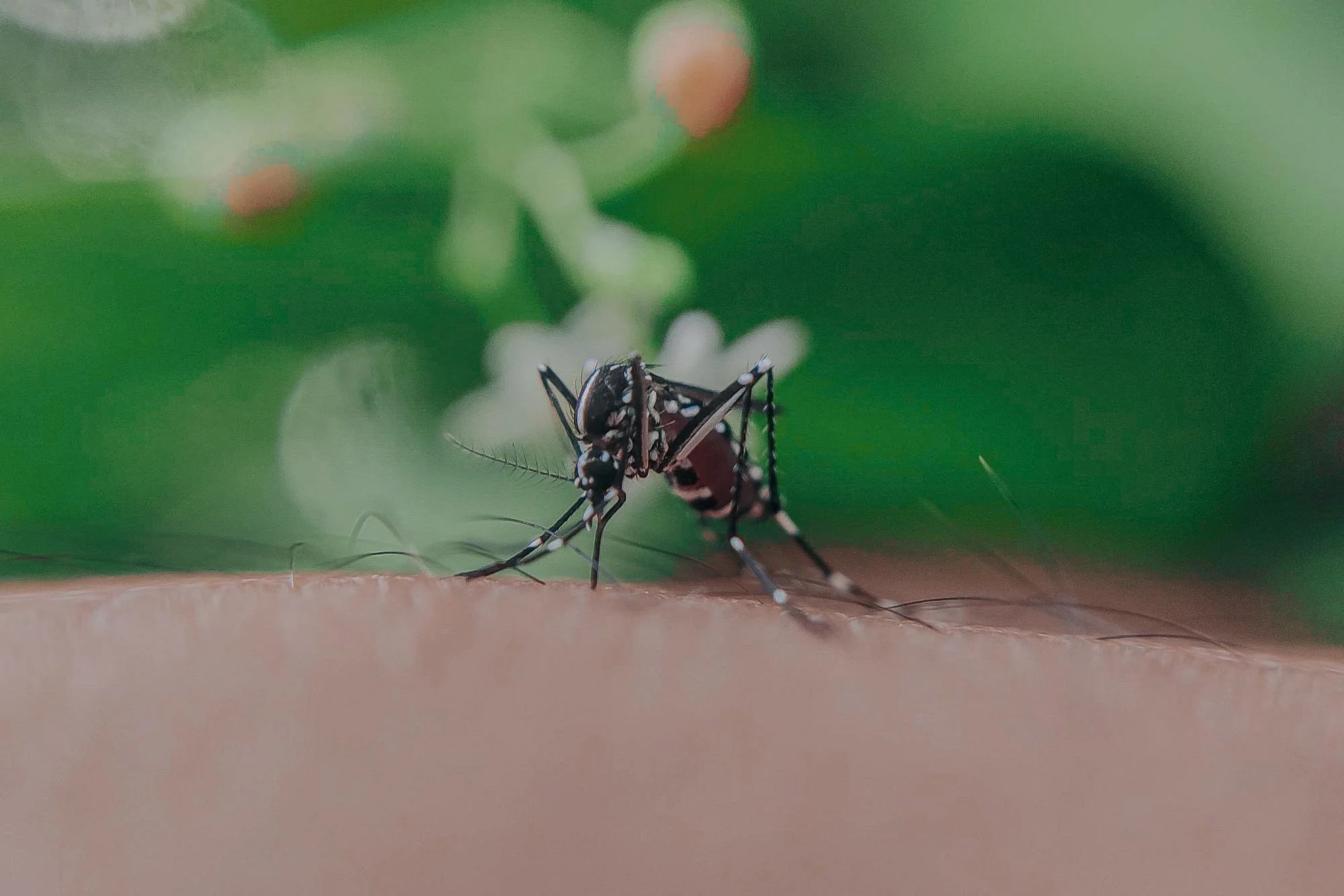
Feel like there's a lot of mosquitoes in Calgary right now? Well, there are.

If you've been outside lately, you've seen them. Or more realistically, you've felt them.
Mosquitoes are back with a vengeance in Calgary this year.
In just the last week, city officials have counted more mosquitoes in their traps than all of 2021 and 2022 (so far) combined.
"We got about 7,000 across four traps," said Alexandra Pepperdine, integrated pest management technician with the City of Calgary in an interview on The Homestretch.
"If you compare that to 2021, we would have gotten about 90. And then in 2020, we would have got about 200 sort of at the same time of the year."
(Credit: Anuj/Pexels)
RELATED: Cooler temperatures are a buzzkill for Winnipeg's swarms of skeeters
The culprit? All that rain.
Mosquitoes develop in standing water — areas like ponds, roadside ditches or depressions in a field. A lot of those breeding grounds formed in June, when about 130.1 mm of rain fell in the city, according to Environment and Climate Change Canada.
Ken Fry, entomologist and instructor at Olds College, suspects the amount of rainfall also caused some dormant mosquito eggs to hatch.
"Their eggs actually can persist … and as soon as the water comes up again from adequate rains, those eggs will hatch," he said.
"It's a really good evolutionary strategy because last year was a drought."
WATCH BELOW: HOW TO MAKE YOURSELF LESS TASTY TO MOSQUITOES
SEE ALSO: Invasion of giant African land snails puts Florida on offensive
Thankfully, warmer temperatures are on the way, and the sunshine could help to dry up mosquito habitats and provide some relief. But more rainfall is still a possibility.
"Let's face it: weather forecasting in Alberta is a bit of a nightmare because of the pop-up thundershowers," said University of Calgary entomologist John Swann last week.
"In theory, they should start to decline."
REDUCING MOSQUITO NUMBERS
Sustained heat is one of the best ways to get mosquito numbers down.
Fry said hotter temperatures make the mosquitoes' metabolism move faster, speeding up their life cycle. The adults die sooner and their eggs hatch faster.
"If we maintain the heat, the water dries up and that means their breeding sites go away and you won't have the following generation," Fry said.
The quick accumulation of water and cool temperatures recently means more mosquitoes than we've experienced in recent memory. But Swann predicts the summer won't be so bad in terms of high mosquito numbers compared to previous years.
The city also says the high number of mosquitoes is not entirely uncommon.
"This isn't a totally atypical year. We have had years where we've collected numbers this high before," Pepperdine said.
The city is also doing its part to help keep mosquito populations in check.
It monitors mosquito species and numbers using two different types of traps. The city also runs an aerial control program, which involves a bacterial insecticide that targets mosquito larvae. It was most recently deployed in the eastern part of the city.
"It obviously can't really do much to control the adult mosquitoes that we are currently seeing right now, but it will help to bring down those numbers in the next few weeks," said Pepperdine.
THE BENEFITS?
Although for humans they're an annoyance, for the ecosystem, a mosquito resurgence is not a total disaster.
Male mosquitoes can actually be pollinators, and all mosquitoes are an important part of the food chain.
"When there is larva in the water, things like fish, minnows will eat them. Other insects like dragonfly larva will eat them. Birds when they're emerging, you'll see swallows and things swooping around the ponds and stillwater grabbing mosquitoes around dusk," Swann said.
VIDEO: THE DOWNSIDE OF BUG ZAPPERS
Say a leaf falls into a pond and begins to dissolve, the mosquitoes will take the small particles leftover for food.
"All this biomass, all this resource is there, but nobody can access it because the bits are too small to grab and chew," Fry said.
"So that's what mosquitoes do, is they filter that organic matter out of the water. So they're cleaning the water. They're converting that organic matter into biomass, their own body."
HOW TO PROTECT YOURSELF
Of course, mosquitoes can carry disease, with West Nile virus being of most concern to Albertans.
To avoid mosquito bites, try to adjust your schedule to keep indoors during dawn and dusk, their prime hours of activity.
If you do go outside, make sure to wear long, light-coloured clothing and bug spray.
Right now, when their numbers are high, also try to avoid shady areas with long grass during the day, Fry said, as that's likely where mosquitoes are resting.
"They'll float up and feed on you. No question."
This article, written by Taylor Simmons, was originally published for CBC News. Contains files from Ellis Choe and Ose Irete.