
Canada’s second-most iconic bird is in danger: What you can do

What’s black and white and facing a population decline across Canada? Loons
A new study has found evidence that common loon populations in Canada may be facing a substantial decline. Researchers analyzed breeding and population data gathered by various monitoring projects over the past few decades, which spanned nine provinces, five states, and 3,421 total lakes.
What they found was an overall decreasing trend in the number of fledglings successfully reared by mated loons, referred to in the study as “productivity.”
"It's a measure of how successful these pairs are at raising chicks that can survive," explained Matthew Fuirst, a Research Ecologist at Birds Canada.
While decreased productivity doesn’t always correlate with population decline, the researchers say it does sound an alarm that we may be seeing the early signs of a major decline in the near future.
"It's mainly that the chicks are not surviving to the age at which then they would contribute to the population."
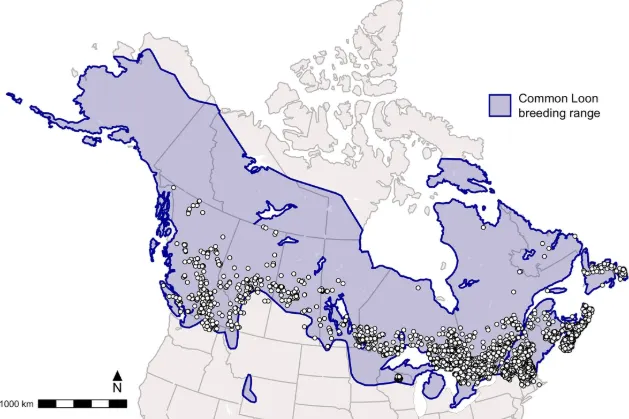
Common loon breeding range in North America, along with points showing each lake that monitored loons used in the study. (Fuirst et al./FACETS (CC BY 4.0))
Prairies and Atlantic Canada show evidence of steepest declines
Decreased productivity was observed across all of Canada’s provinces and was categorized between provinces based on the strength of evidence.
Strong evidence of a steep decline in loon productivity was found in Atlantic Canada and the Prairies, where data showed 74 per cent and 65 per cent declines, respectively, between 1992 and 2023.
Moderate evidence of decline was found across Ontario, where a 45 per cent decline was recorded between 1981 and 2023. While that number seems comparable to Atlantic Canada or the Prairies, it’s important to note the longer timeframe. In actuality, the data shows an approximate 1.08 per cent decline per year in Ontario, compared to the 2.39 and 2.09 per cent yearly decline in Atlantic Canada and the Prairies.
Meanwhile, British Columbia had weak evidence of productivity decline and Quebec showed near-stable levels, although leaning on the negative side.
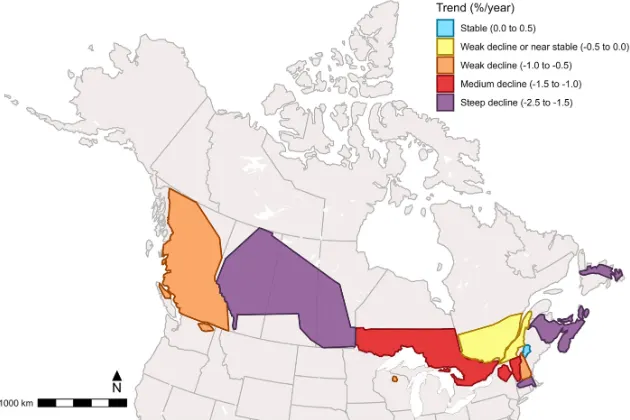
Map showing the overall loon productivity trend in per cent per year across the regions studied. (Fuirst et al./FACETS (CC BY 4.0))
Climate change, land-use among possible causes
There is no single known cause of this reported decline in loon productivity and population growth.
"We don't know why. We understand that there are region specific threats for loons and some broader scale threats that we're hoping to dive more into," Fuirst commented.
However, researchers are confident that climate change and human activity play a significant role.
"One is climate change influencing acid rain and that then leading to lakes becoming more acidic," Fuirst said. "And when lakes are more acidic, they're less hospitable for fish that the loons rely on to eat. The second pathway that we expect is that with climate change and precipitation events becoming more heavy or more frequent, it reduces the clarity of the lakes because there's increased runoff. And it, you know, makes the water in the lake move when it rains and that makes it more challenging for loons to hunt."
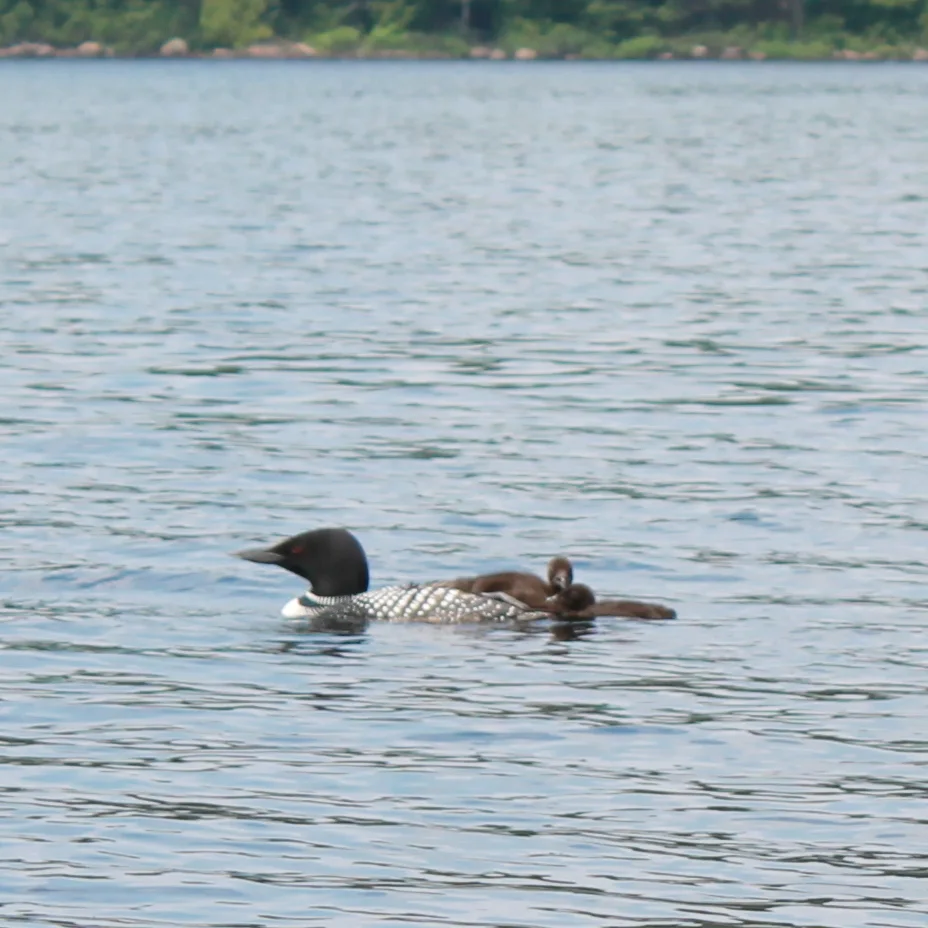
Loons often carry their offspring on their backs to protect the babies from predators and to help conserve energy. (Credit: Kevin Clarke)
Another hypothesis that was proposed suggests human shoreline use and development has contributed to decreased productivity in loons through destruction, contamination, or general disturbances from human activities.
"Lead tackle is the number one cause of mortality in adult loons," Fuirst warned. "All it takes is one lead sinker or a jig to kill a loon."
Other possible causes listed in the study include:
Increased chick predation by raccoons and eagles
Increased black fly populations
Methylmercury contamination from increased pollution
What you can do to help your local loons
If you want to play an active role in protecting Canada’s second-most iconic bird, you can volunteer in the Canadian Lakes Loon Survey. This annual event is dedicated to monitoring loon populations and breeding across Canada, as well as sharing observations and acting as a steward for our lake-dwelling avian friends.
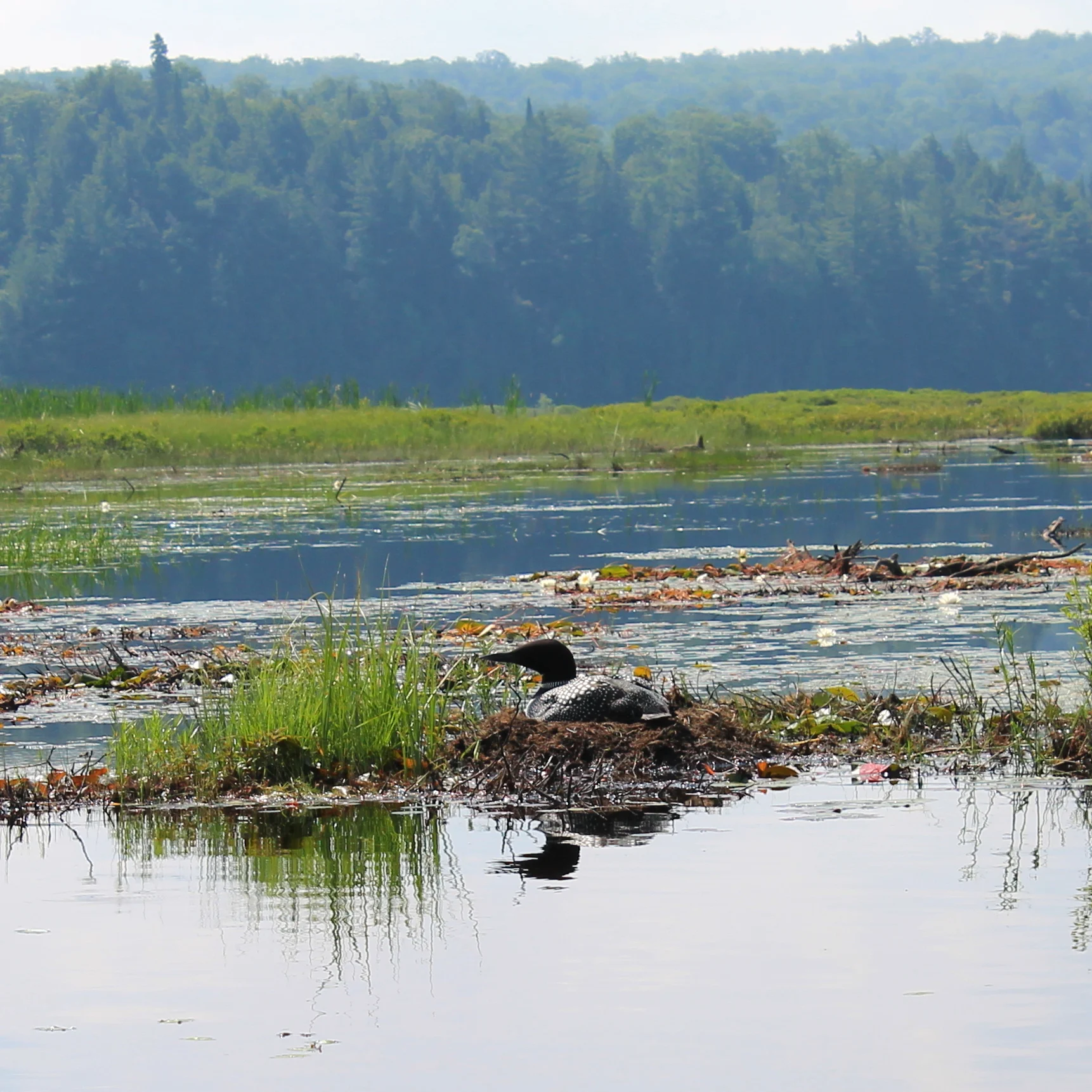
Repeated flood events or increased blackfly populations may cause a loon pair to abandon their nest. (Credit: Kevin Clarke)
However, if you’d rather play a more passive role in supporting loon populations, there are plenty of other things you can do, such as:
Slow down when boating near wetlands or shorelines
Keep a respectful distance away from loons on the lake
Use lead-free fishing tackle
Opt for a naturalized shoreline
Clean up litter along the shoreline
"94 per cent of the world's breeding population of common loons resides in Canada. And so it's kind of our responsibility within Canada to care for the lakes that these loons rely on."
More tips and resources about how you can help support your local loons can be found at Birds Canada.
Thumbnail image courtesy of Seth Macey.