Arctic communities testing new 'bear-dar' to detect wildlife threats

Nobody really wants to come face-to-face with a polar bear.
Inuit, for millennia, have used highly-developed observational skills and generational knowledge to detect the animals.
But conservation group Polar Bears International thought, what if there was a way to supplement that with technology to protect everybody?
“That led us to some security systems that were originally developed for the military and to see if that might have a wildlife application,” said Geoff York, Polar Bear International's senior director of research and policy.
Enter "bear-dar."
CHECK OUT: How the weather could influence your music taste
Bear-dar is a fixed radar that’s designed to survey the landscape and detect anything that moves. It can be used as an early warning system, alerting communities that a bear is nearby.
"You can have it send you a text message, you can have it send you an email, you can have it trigger a flashing light. You can even have it trigger potentially what we'd call a remote deterrent. So it could trigger a strobe light, it could trigger a certain noise that might startle a bear, all remotely,” said York.

This 'bear-dar' system was installed at Eureka's weather station in the Qikiqtaaluk region of Nunavut in August 2025. Environment and Climate Change Canada says it's a tool they could use to potentially improve staff safety. (Submitted to CBC News by Polar Bear International)
Polar Bear International, alongside a military technology developer called Spotter Global, have spent years fine-tuning the technology in Churchill, Man., where polar bear sightings are frequent.
It included teaching the artificial intelligence-powered system what’s a polar bear, and what’s just another big, moving object. The system is continuously being trained.
Increased polar bear presence at Eureka
The system was installed in August 2025 at the Eureka weather station in the Qikiqtaaluk region of Nunavut, where Environment and Climate Change Canada (ECCC) has nine staff and contractors positioned. ECCC has reported an increased polar bear presence there in recent years.
“It is early days when it comes to evaluation. For ECCC, (bear-dar) is potentially a tool to support the safety of staff by alerting them to the presence of polar bears or other wildlife, like wolves, notably during the months of low light and polar darkness,” ECCC wrote in an email.
Communities in the Norwegian archipelago of Svalbard are looking to test the technology out this winter.
DON'T MISS: Mobile treadmill van helps dogs stay active during bad weather
About 300 polar bears stay in Svalbard year-round, rather than hunting on the ice edge, according to the World Wildlife Fund.

Hilde Fålun Strøm with her husband. Over the three decades Strøm has lived in Svalbard, she said she's witnessed drastic changes to the environment. (Submitted to CBC News by Hilde Fålun Strøm )
Hilde Fålun Strøm, a citizen scientist and Polar Bear International ambassador, has lived in Svalbard for more than three decades and has witnessed the effects of climate change pushing polar bears closer to civilization.
“I've seen devastating avalanches and landslides and melting glaciers. We, as a community, see more polar bears on land. Polar bears need to… find other things to live off,” she said.
Right now, communities in Svalbard rely on human observation to detect polar bears. In Strøm’s view, the bear-dar could help keep both humans and animals safe.
“We are the visitors here and we are in their territory. So [we could] be alerted by them coming and find ways to use soft deterrents to scare them away,” she said.
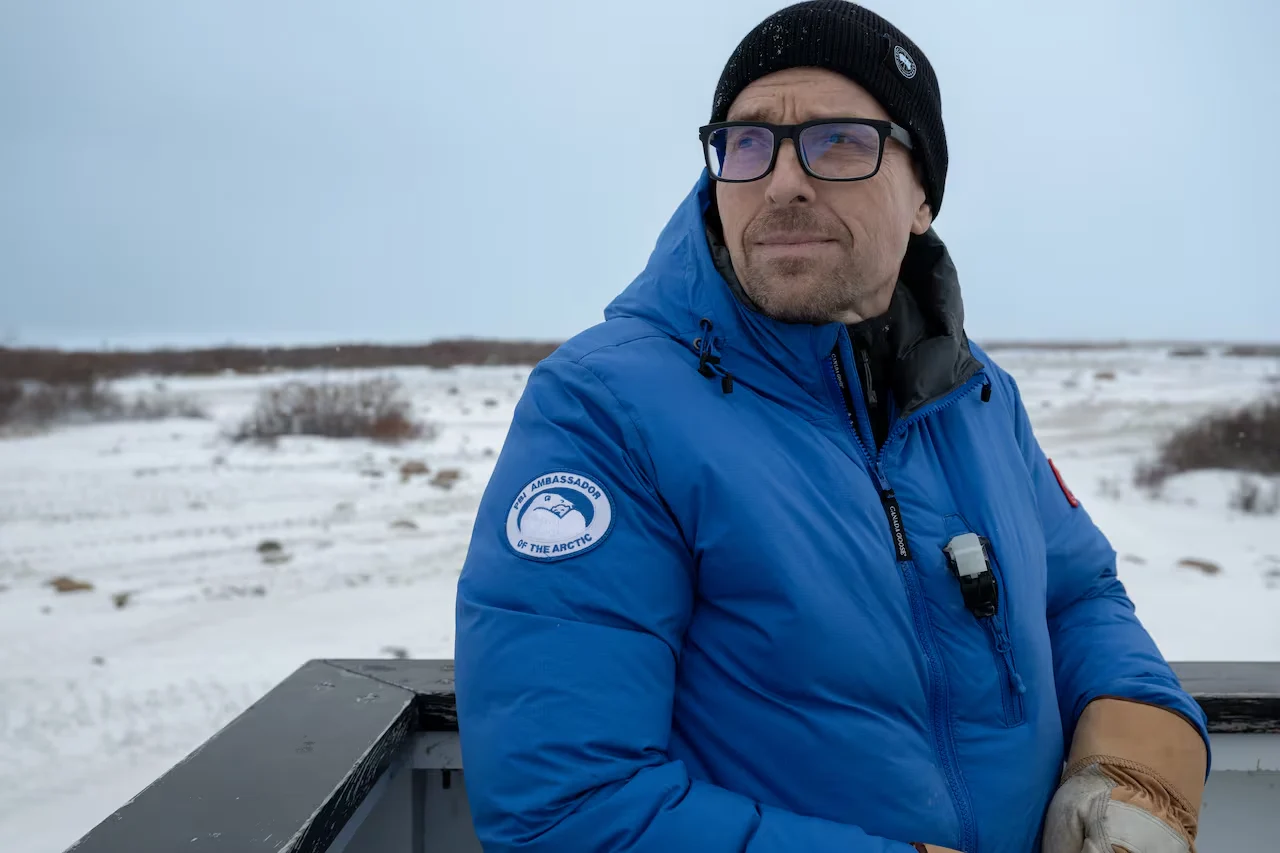
Geoff York, senior director of research and policy at Polar Bears International, says this bear-dar technology has inspired the group to further explore visual detection technology. (Photo by Jenny Wong/ Polar Bears International)
SEE ALSO: Why Florida's iguanas fall from the sky when frigid air arrives
But this technology isn't cheap. York said the base model package is around $60,000, and it could get more expensive if it’s being used to protect an entire community.
"At the end of the day, we're not in the radar business. We just wanted to see what this could do and we'll turn it back over to private partners to take it from there,” he said.
What this technology does prove, he said, is the possibilities of visual detection software, and communities can decide whether that's something they would like to explore further.
This article, originally published by CBC News on January 03, 2026, was written by Samuel Wat.