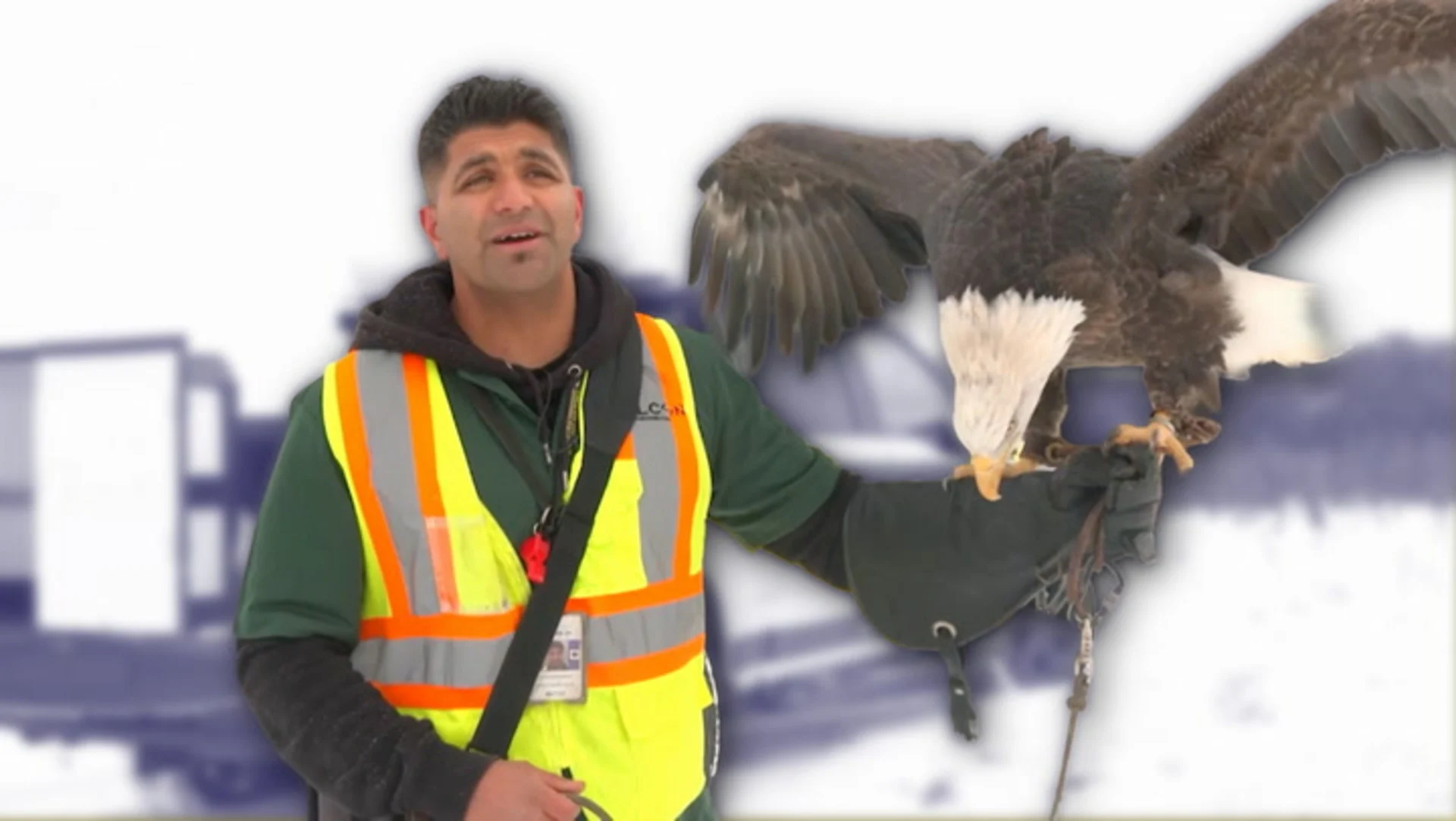
This eagle protects planes at Canada's busiest airport. Here's how

At Toronto Pearson Airport, a dedicated team from Falcon Environmental uses a unique approach to keep the skies clear, featuring their star employee, Ivan the bald eagle. The Weather Network's Mark Robinson spoke to the experts about how they use falconry to protect both passengers and wildlife.
The roar of the engine cut through the conversation with a suddenness that, while I was expecting it, was still surprising. Talking with Sulaiman "Sully" Momla, one of the team of humans and birds that ensure that wildlife doesn’t interfere with the aircraft at Pearson Airport, became more yelling than polite.
“Aren’t you worried about those birds that are heading for the runway?” I asked over the roar.
Momla, lead raptor trainer for Falcon Environmental, shook his head and pointed to what was, to me, no more than a dozen dots in the distance. “Nope, they’ve already turned, and they’re heading south again. No problem!”
The Air Canada plane was across the runway on the other side of the gigantic field that made up most of the territory on which Pearson Airport had been built, and even that far away, a big plane spooling up its engines for takeoff was deafening.
The sound didn’t even make Ivan, the bald eagle, look up. He’d obviously been around aircraft for so long that this was just another Tuesday to him.
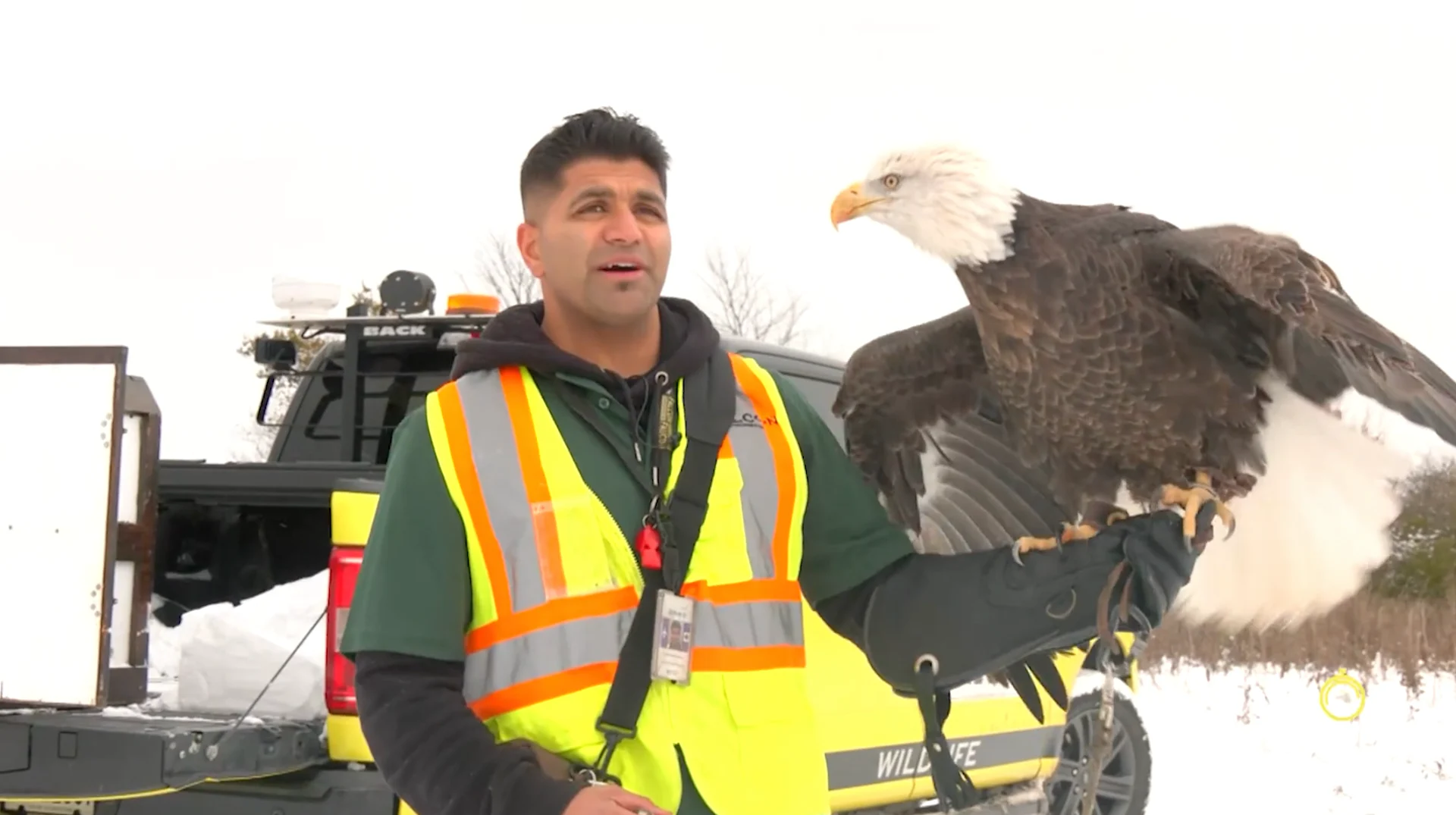
Sulaiman "Sully" Momla, lead raptor trainer for Falcon Environmental, pictured with Ivan the eagle. (The Weather Network)
SEE ALSO: How Pearson Airport navigates tough winter weather
Ivan is part of a team that I’d wanted to learn more about for a long time, and standing there in the snow as planes landed and took off around me, I got an amazing lesson in what it takes to keep planes coming and going at Pearson Airport.
Landings and takeoffs are the most dangerous part of any aircraft flight—not just because you’re dealing with the vagaries of the weather close to the surface, but also because pilots have to pay attention to wildlife like birds and even coyotes while moving at 300 km/h.
This is why wildlife control at airports like Pearson is a critical part of the smooth operation of air transport; wildlife is unpredictable and ubiquitous in and around Toronto and Mississauga, where Pearson is located.
In 2022, 1689 bird strikes were reported to Transport Canada, and while only four per cent of those collisions caused significant damage to the aircraft, the majority happened during the most critical stage of the flight, takeoff and landing. When something goes wrong and the ground is that close, there’s not a lot of time or room to manoeuvre.
“Our job here at Pearson as wildlife control officers is to maintain operational balance," explained Momla. "We do this by reducing wildlife hazards around the airport, and to do that, we’re here an hour before sunrise to an hour after sunset every single day of the year. We patrol the airfield with our birds and capitalize on the predator-prey relationship. Think of it like educating the wildlife that the area isn’t a good or safe place to be.”
Falcon Environmental has a flock of around 30 birds, including falcons, Harris hawks, and even a bald eagle for larger birds like Canada geese. The entire team is always busy given that Pearson is on the migratory pathway of many bird species across North America, it’s close to Lake Ontario, and the airfield has at least three creeks and a large river in and around the property. All of these are prime bird habitats, which means that there’s a constant stream of avian and more ground-based animal visitors to the airport.
Momla stresses that the team’s job isn’t wiping out all wildlife around Pearson.
“If we had to eliminate all the wildlife, that’s just not sustainable, and they’d just get replaced by other wildlife. So, if we’re constantly educating birds, they teach each other that it’s not a safe place to be," Momla clarified. "The reality is that we built our airport on wildlife habitat, and we have to be responsible and coexist."
Momla takes his job seriously because bird strikes on aircraft can be disastrous.
“The analogy I like to use goes like this: imagine you’re driving down the highway and a small stone hits your windshield. You might get a crack or a chip. Aircraft are taking off at around 300 km/h, and they have an impact with a bird. Now, small birds can weigh a few grams, but geese can be as much as 3000 grams—that’s around 10 pounds on average. And, birds of a feather flock together, so 30 geese could be 300 pounds hitting the aircraft. Now imagine 3000 starlings. Same result. So, our team is here every day to try and prevent that hazard.”
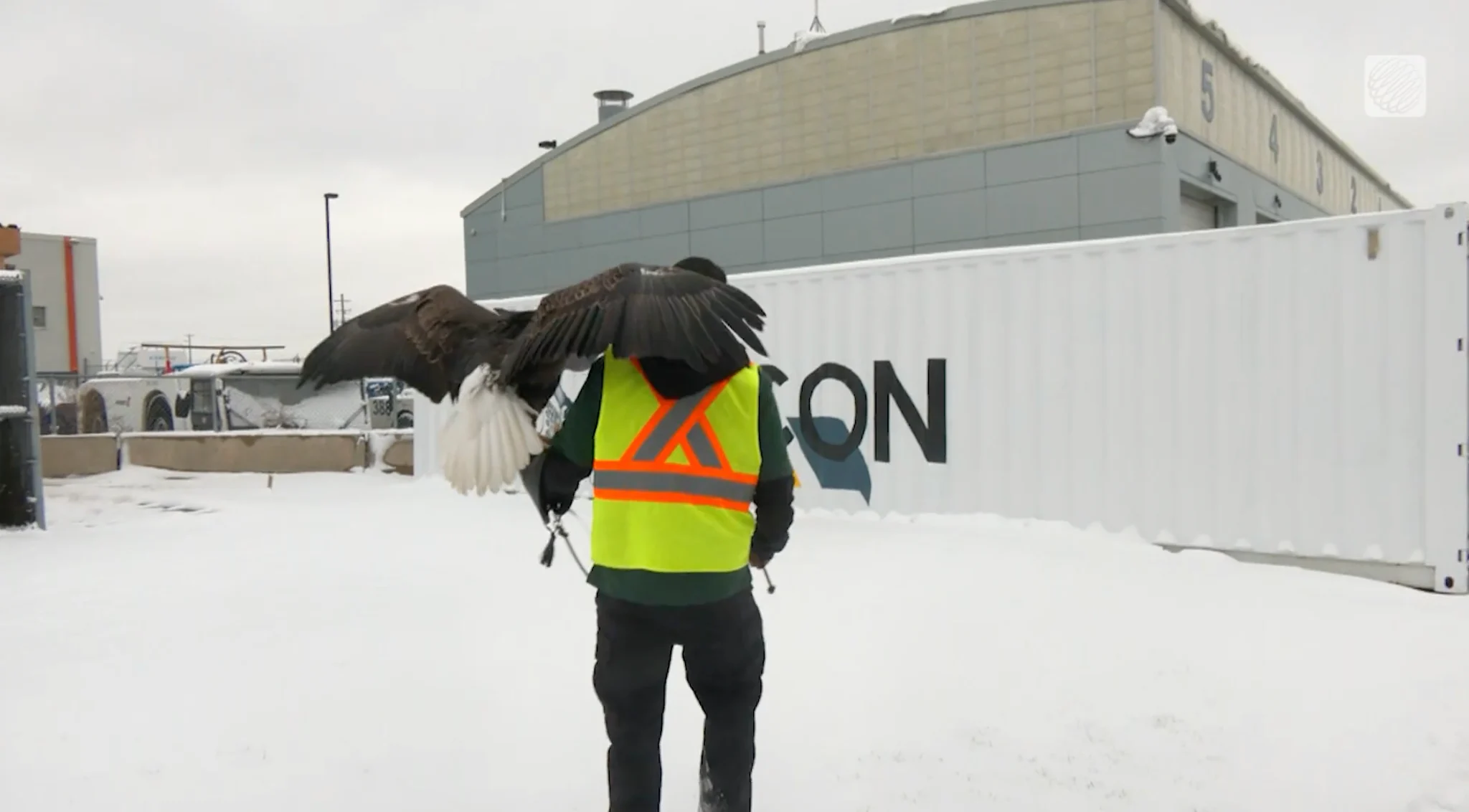
Weighing in at about 7 pounds, Ivan is the biggest bird of prey used at Toronto Pearson. (The Weather Network)
RELATED: Dodging dive-bombs: This hawk keeps the Halifax Waterfront free of pesky gulls
In that vein, the team is in constant contact with the control tower and can even ask for delays in takeoff and landing.
“If we feel that a plane should go around or go higher than the birds, we can make that call, and yes, that could cause delays,” Momla added.
My feeling is that please delay me if it means a safe takeoff or landing, and my guess is you feel the same.
The chance for bird collisions is dependent on seasons, as you might imagine. Migratory times are especially high risk.
“Fall and spring migration are definitely a busier time for us," Momla said. "We get an influx of bird activity, and that does increase the hazard. We’ve been collecting data for decades now, and we aim to keep a step ahead of the birds. We know that if a cold front is coming in and birds are flying with it, we increase patrols, check our hot spots, and refine our techniques to be more effective."
The sound of the engines faded as the aircraft disappeared into the low cloud that covered the sky above Pearson, and even as it did, a new engine noise echoed over us as another plane emerged from that same cloud deck and aimed at the long pavement of the runway in full landing configuration.
“My favourite part of the job is flying the birds and also not knowing what’s going to come next. One minute you’re flying a bird, or training a bird; the next moment you’re driving down a runway looking for something or chasing a coyote, or you’re in the belly of an aircraft trying to get a dog back into its kennel.”
Momla laughed, “It stays exciting, that’s for sure.”