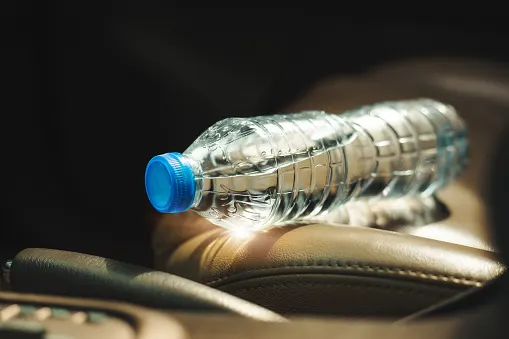
Here's why leaving a plastic water bottle in your car can be risky

The plastic bottle can act as a magnifying glass and produce enough heat to start a fire.
When hot weather hits, it's important to stay hydrated, but don't leave your plastic water bottle behind in the car.
When the heat, sun, and the bottle lines up just right it can cause a small fire. If the sun is strong enough, a bottle can act like a lens that channels light into a high-powered beam, strong enough to burn a car's upholstery.
As a case in point, Idaho Power uploaded a video to YouTube in 2018, featuring a water bottle burning two small holes into a car.
"This is a good illustration of just how much energy there is coming from the sun," Michael Doutre, a chemist at the Getty Conservation Institute who studies plastic, told Live Science.
"We think of this as a cheap water bottle, but we're unintentionally creating an optically almost-perfect shape for a lens."
Doutre told the outlet that after sunlight passes through a car window, it can hit a seat with about 600 watts per square meter of energy, which is roughly equivalent to the heat generated by a small electric space heater.
While fire-retardant materials inside a vehicle would likely prevent it from igniting, the water bottle-turned-laser could leave behind a nasty burn mark.
For a flame to catch, the liquid in the bottle must be clear so that a sufficient amount of light can pass through.
Water + warmth = Bacteria
Still water in a warm environment creates an opportune breeding ground for bacteria, especially if you've already taken a few sips. Bacteria from your mouth can easily enter the water and, if it sits in the heat for a few hours, it can multiply, which could make you sick.
The microplastic problem
Plastic water bottles can shed microplastics, i.e., tiny plastic particles usually just a few millimetres in size.
Heat can speed up this process, potentially potentially contaminating your water.
“The hotter it gets, the more the stuff in plastic can move into food or drinking water,” Rolf Halden, director of the Center for Environmental Health Engineering at Arizona State University’s Biodesign Institute, told National Geographic in 2019.
Be sure to watch the video that leads this article for more information — and spread the word.
VIDEO: Here's why fans aren't your friend in an extreme heat event
--
Thumbnail credit: Getty Images/stock photo.