
Three things to know about the flu with kids back at school

While data suggests the flu season may have passed its peak, caution is still advised, especially with kids back in school. Discover why the dominant H3N2 strain is affecting young children more this year and what early data says about the vaccine's effectiveness.
1. Experts believe the flu may have peaked, but we need to remain vigilant
While the flu will be circulating for several more months, experts believe its peak has passed.
In a Jan. 9 interview with The Weather Network, Dr. Elani Galanis, director-general of the Centre for Emerging and Respiratory Infections and Pandemic Preparedness at the Public Health Agency of Canada (PHAC), said the agency is seeing a drop in test positivity.
PHAC’s latest data shows a drop from a peak of 33 per cent, which the agency says is the highest peak rate in three years, down to 27 per cent.
“The season started in November, and typically peaks after about seven weeks. That’s exactly what we saw again this [season],” Galanis says.
“The incidence, or the number of cases, and the per cent positive lab sample for influenza peaked in the week of Dec. 21, so the week of Christmas.”

(Storyblocks)
You may recall seeing headlines suggesting this year’s flu season was becoming more severe, earlier than usual. Galanis attributes this to geographic synchronization. That is, this flu season saw the illness impact all provinces at the same time. Typically it will drift across the country from west to east., according to a study conducted at McMaster University.
Of course, this means that those getting tested for respiratory illnesses have other viruses.
According to the latest PHAC respiratory virus report, test positivity is currently highest for enterovirus/rhinovirus (the viruses that cause the common cold). The test positivity rate for respiratory syncytial virus is increasing but “is below expected levels." Test positivity for COVID-19 has increased, too.
Still, Galanis calls this “very much an influenza-focused winter,” and reminds people that all of these viruses are still circulating and outcomes can still be severe. She says Canada typically sees some strain of influenza circulate widely well into February and even into March.
“The downslope for flu can last quite a while, both because the strain of flu that caused this peak will still be around for several more weeks, and because we do see secondary strains that tend to peak a little bit later in the season.”
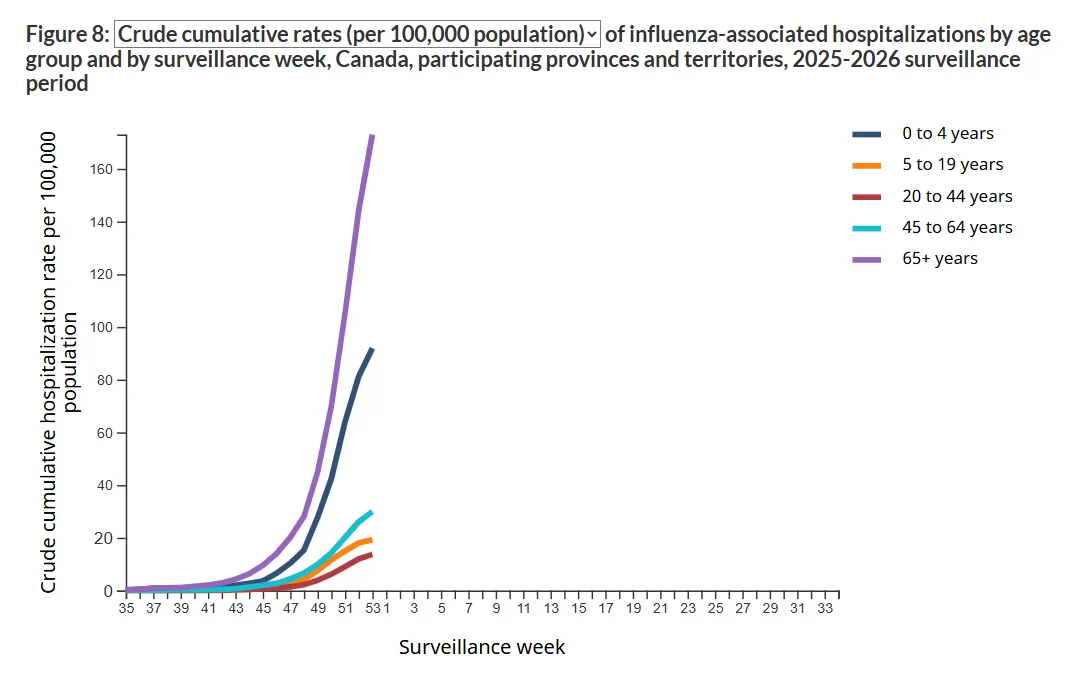
Data shows flu-related hospitalizations are highest among older Canadians, and the very young. (Public Health Agency of Canada (PHAC)/Submitted to The Weather Network)
2. More children infected this year than in the immediate past, but severe outcomes in the age group are still rare
With kids back in school after the Christmas break, parents are likely wondering what risk exists for their children, and how they can keep them safe.
And indeed, Galanis says Canada is recording more cases among children than we’ve seen in recent this--for an obvious reason.
The dominant circulating strain of influenza in Canada this season has been influenza-A, H3N2.
“We haven’t seen much of it since 2022, so the kids who were born since then will not have any immunity against it, especially if they’re not vaccinated,” Galanis explains.
“And then, not all the kids in 2022 got infected so they would have been at higher risk of infection, given they wouldn’t have seen this strain before.”
But, while every severe outcome in children is worth pause, data shows young people are still far less likely to experience complications like hospitalizations and intensive care unit (ICU) admissions.
Since Aug. 24, 2025, PHAC’s pediatric (under 18 years old) monitoring program has reported 617 hospitalizations, 75 ICU admissions and under five deaths resulting from the flu.
Over the same time frame, PHAC reports 16,167 hospitalizations, 354 ICU admissions and 233 deaths in total from the flu. Galanis noted that not all provinces and territories report severe outcomes.
3. Vaccination is still a good idea, even if we’re past the peak
Despite concerns early in the flu season about a mismatch between the strains the flu vaccine was developed for, and the strain that became dominant, Galanis says data is showing vaccination is still providing significant protection.
“The dominant strain so far this season in Canada and most parts of the world is influenza-A H3N2, subclade ‘K’,” she says.
“We were concerned that it had accumulated mutations over the summer months, and potentially wouldn’t be a good match for the vaccine but it turns out that vaccine effectiveness was actually very decent this year, based on data coming out from the U.K. (United Kingdom) and [other parts of] Europe.”
That data, she says, puts vaccine effectiveness (its ability to prevent severe illness) at around 40 per cent, a rate she calls “very decent” given that effectiveness can range from 60 per cent all the way down to 10 per cent in any given year.
And, given that the flu will circulate for several more months, it’s still a good idea to get the shot.
“There’s still time to vaccinate, there would still be benefits to vaccination, particularly those at higher risk for severe outcomes,” Galanis says.
“In the U.K., the vaccine was particularly effective at limiting and preventing hospitalizations among children. And if you do get sick, please stay home and wear a mask particularly to protect the very vulnerable. ”
WATCH BELOW: Flu vaccine a mismatch for dominant strain in Canada this season
Thumbnail courtesy of Storyblocks.